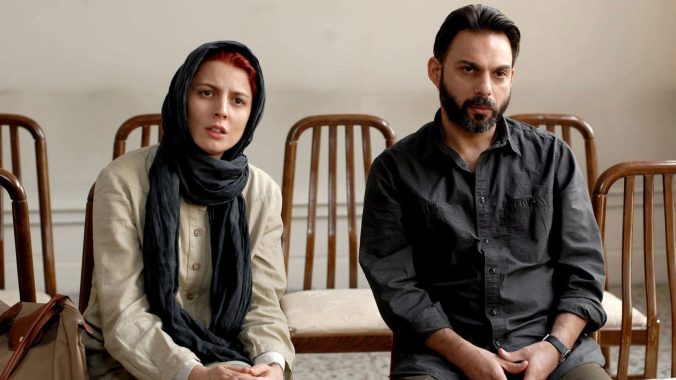
5 – A Separation – Asghar Farhadi – 2011 – Iran
A Separation is an easy choice to start the final part of my top 20. This was my first Asghar Farhadi film and I wandered into it based on word of mouth hype during the fest. Here is an example of a drama that works best when you go in completely blind and let the storyteller do his thing. Farhadi has been making films in Iran since the early 2000s and has developed a formula all his own that works to stunning effect in A Separation.
Nader and Simin are going through a divorce and trying their best to do what’s right for their teen daughter. Nader hires a housekeeper to help take care of his father who suffers from Alzheimer’s. The woman, Razieh is a very religious, married, pregnant woman who takes the job in secret from her husband to help pay bills without upsetting his traditional ways. The job of caring for Nader’s father proves to be too much for Razieh, who is also taking care of her young daughter who tags along while she works. After losing track of the old man one day, Razieh is fired and this starts a series of events that sends shockwaves through both family units.
A Separation is a superbly balanced moral dilemma that presents a cast of flawed, but good characters fleshed out by authentic, unaffected acting performances. The film is intimately shot, but leaves plenty of room for symbolism and visual poetry. Often the characters are shown on opposite ends of a wall, a door or a pane of glass. These separators, of course, call to the title of the film, but also the large divides that occur in our own homes between family members, or the gaps created by wealth and religion.
This film asks very difficult questions and just when you think you have an answer, things shift and the moral ground is suddenly impossible to navigate. The truth becomes formless and malleable. Small secrets and lies fester and grow until they are released in heartfelt confessions, too late to repair the damage that has been done. I remember my experience in the theater as things fell into place and I was drawn further and further forward in my seat, a small grin at the clever twists, until I myself was twisted and tied into a million little knots, rolling around in the aisle trying to contain myself.

4 – The Films of Hong Sang Soo – 2010 to 2019 – Korea
That’s right. I’m not gonna choose on this one. I considered a few options to pick from the prolific director’s fourteen film decade, but decided that it was not a single film, but the cumulative effect of all of these films that had such a profound effect on me. To be truthful, the first Hong Sang Soo movie that I saw, back in 2010, HaHaHa, left me so confounded that I was frustrated. The audience was primarily Korean and laughed uproariously throughout. I couldn’t help feeling like I was on the outside looking in. Perhaps there was some cultural understanding that I just didn’t have and this filmmaker, whose name was quickly surfacing in the discourse, was just too Korean for me. In spite of this, I found myself seeing more of his work, trying to figure out what the big deal was. The second film I saw was The Day He Arrives in 2011 and the change was subtle, but did not go unnoticed. This film had me giggling along with the rest of the crowd. The snow covered black and white cinematography was gorgeous and the repetitive pacing and soft tone was charming. I wasn’t sold on Hong, yet, but I was no longer feeling left out.
I skipped his 2012 output and a couple years later moved out to Japan with my wife. While I was out there, I decided to watch 2013’s Hill of Freedom, a story about a Japanese man who takes a trip to Korea to track down a Korean girl he had fell in love with years before. He stays in a guesthouse near her home and waits in a cafe hoping to see her. Most of the scenes in Hill of Freedom are in broken English between the Japanese man and the Korean people living around him. The effect of two people communicating through a shared language that is not their own is both hilarious and endearing. When you eliminate the comfort of a first language, people are left unguarded and open. Hong recognizes that and fills the film with fumbling scenes of small talk and empty politeness. This so closely mirrored my experience at the time, a foreigner in small town Japan, my chances for deep communication were few and the moments when I could forge a connection with another human being usually employed the most basic of English expression. There in my bedroom, my television cranked to max to drown out the deafening cicadas, suddenly everything clicked. The long shots of drunken conversation, the hand painted title cards and chamber music, the confusing sense of reality and time. I was in love. Since this day I cannot sit through a Hong Sang-Soo movie without weeping throughout. I can’t explain the effect these films have on me, but they cut deep to my core and leave me helpless in their confident, humanist portrayals of life.
Hong Sang-Soo is known for repeating himself. Much like Farhadi, who directed the previous selection in this list, he has a formula and sticks to it. A small group of Korean intellectuals or artists, get drunk, usually two at a time and tear themselves or eachother apart. There are conversations about art and philosophy, there are tears and sex. Everything unfolds over a series of single shot scenes, written earlier that day, and always there is inevitably a camera zoom. The Hong Sang-Soo zoom is my favourite thing in films in this decade. It sounds silly, but he has boiled down this simple, clumsy camera movement into a finely tuned technique that can inspire both outrageous laughter and breathless tears. When I watch his films in a theater I have to force myself not to clap every time it happens. My wife can attest I am unable to keep quiet when I watch a Hong film at home.
So I can’t and I won’t pick a favourite. I am quite partial to the films of Hong that are not completely in Korean. The language barrier films, In Another Country, Hill of Freedom and Claire’s Camera are good examples of when Hong uses this hurdle to dig deeper at low stakes, temporary relationships and how people can find meaning and purpose in each other without being able to communicate. Film’s like On the Beach at Night Alone and Nobody’s Daughter Haewon start in similar fashion, following characters on vacation in Europe, who return home to Korea and for different reasons fall into deep depression. Heavy with sadness, these films are painful and beautiful and full of strong performances.
Perhaps the most interesting type of Hong film are the ones that play with the concepts of time and reality. Right Now, Wrong Then may be the best example of that, and is also the film I chose to include as a screenshot above. Told in two parts, the first of which follows a director who is in Seoul to screen his newest film. He comes across a beautiful young lady (Kim Min-Hee, the director’s recent muse and lover, which is a whole ‘nother can of worms I don’t have the time to get into here) and is smitten. He strikes up a conversation and learns she is a painter. They go to her studio where he compliments her work profoundly. They get drunk and he confesses his love to her. Things play out for a bit and eventually fall apart as they get to know eachother better and then half way into the film, we go back to the start and do it all again, but this time things are slightly different. Like watching a movie over again through a fun house mirror, things play out in similar fashion, but the details and more importantly the energy is completely different. By the time they arrive at her studio and he insults her by saying that her art is fundamentally sound, but lacks soul, the differences are both subtle and groundbreaking.
So again. I can’t choose just one. Because of that, I have these films placed at #4 because I have three single pieces that I knew from the start were my three top movies. With that being said, Hong Sang-Soo is without question the most important filmmaker for me in this decade.
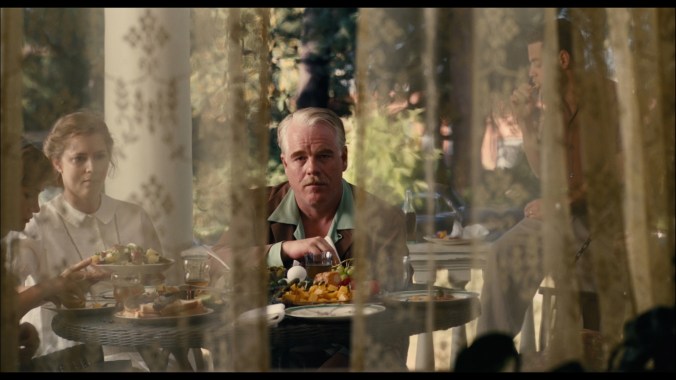
3 – The Master – Paul Thomas Anderson – 2012 – USA
I credit the films of Paul Thomas Anderson with igniting my love for cinema and setting me off to see as much as I could and refine my understanding of the medium over the last 17 years of my life. That after all this time, I can still sit here and cite a PTA film as one of my top 3 of the decade is amazing to me. Some of my other favourite directors from that time in my life made some really terrific films this decade, but none of them actually appear on this list. Aside from a few exceptions this list is composed of filmmakers who were totally new to me in this decade. When I saw The Master back in 2012, it hit me hard in a way I didn’t and still don’t full understand, but I knew from that moment it was PTA’s best work and find myself returning to it on a yearly basis since.
Of course the performances in this film are a huge draw. Joaquin Phoenix as Freddy Quell and Philip Seymour Hoffman as Lancaster Dodd turn in their best performances and work off of each other to establish a mesmerizing dynamic as they butt heads and hug it out over the control of one’s mind. This is Paul Thomas Anderson at his most focused and aware. A pared down and mysterious film that obscures the need for any message and instead asks you to just feel a connection. There is no clear conflict. No precise goal.
I think the closest we come to a clear answer is when Dodd tells Freddy “If you figure out a way to live without a master, any master, be sure to let the rest of us know, for you would be the first in the history of the world.” The weight of these words lands different on me each time I see this film. I think this is partly owed to the delivery of the late, great Hoffman, who was lost, grappling with his own master. His desperation and longing as he sings “Slow Boat to China” is my favourite acting moment in the decade and one of my favourite scenes ever. The Master is a painfully accurate depiction of dependence and addiction and yet I find myself wondering if the prospect of living life without a master would even be worth it. Difficult and essential. A film to grow old with.

2 – Poetry – Lee Chang-Dong – 2010 – Korea
Speaking of films to grow old with. Here is a film from the very beginning of the decade. I didn’t want to double up on directors in this list, but Lee Chang-Dong’s Burning is an absolute favourite from 2018, and there was no way that it was going to bump Poetry out of my top 3, as I have many times called it my favourite movie of all time. 2010 was a long time ago, as I’ve been exploring throughout this list, but every time I have revisited Poetry it has only hit me harder.
Mi-Ja is 66 and takes care of her 16-year-old grandson. We meet her in a doctor’s office, she is starting to become forgetful and is having trouble remembering words. She works part time taking care of a wealthy old man, who has been paralyzed from a stroke. On her way home one day, she notices a poster for an adult poetry class and decides to sign up. The teacher tasks the class with writing one poem by the end of the month-long course and she is encouraged to look deeper at the objects around her, to see them as they really are. She spends the days admiring flowers and taking notes.
Meanwhile Mi-Ja finds out that her grandson, along with a few of his friends, are responsible for the death of a female classmate. The nature of his crime is horrific and Mi-Ja is swept up in the proceedings as the families of the boys debate how much money would be appropriate for them to give to the poor, bereaved family. Mi-Ja drifts away from these brutal conversations to examine a flower on the table, lost in her newfound world of poetry. She attends poetry readings with members from her class and they go for dinner with their teacher, a famous poet and discuss poems and what constitutes art. Mi-Ja is sent by the other parents, to the countryside to reach out to the dead girl’s mother. When she finally meets her face to face, she can only bring up how beautiful the flowers in the area are. She finally concocts a plan to get the money she owes from the old man she takes care of.
The underlying plot in Poetry is tense and exciting. It is a slow, methodical film that takes it’s time in setting everything up, but once it gets there, Lee delivers some of the most acutely profound images ever committed to film. A particular shot of the grandson playing with a few neighborhood children, showing the younger ones how to hula hoop. A hat blown by the wind into a rushing river. A game of badminton in a dark street. These moments explode with pain and joy. In Poetry we are shown the beauty in everything. When Mi-Ja finally delivers her poem, I have no words for the amount of emotion that runs through me. Even thinking about it now has me in tears. I cannot recommend this film enough. I hope those who have not seen it yet will take my word for it and seek it out, you will not regret it.
1 – Toni Erdmann – Maren Ade – 2016 – Germany
So after reading all of this, I’m sure what you expected in first place was a comedy, right? Albiet a German comedy that clocks in at nearly 3 hours in running time, but still, a bit of a left turn. I did not know what to expect when I sat down in the theatre in 2016 to see Toni Erdmann, but the considerable buzz was certainly in the air at that point. Within minutes, I and the packed theater at The Centre in Vancouver were screaming with laughter which did not stop for the next 160 minutes.
The story of a father and a daughter who have nothing in common. The father, Winfried is a goofball music teacher obsessed with playing pranks that only he seems to get a kick out of. His main gag involves slapping in a pair of fake teeth over his real ones and letting them stick out from under his lip. It’s stupid, but the joke is never treated as something actually funny and rather the other characters generally roll their eyes and laugh it off. His daughter, Ines is an upwardly mobile woman climbing the corporate ladder in a consultation firm doing work in Romania. She has no time for nonsense and regards her father with a scoffing sense of disdain.
When his dog passes away, Winfried takes an impromptu trip to Bucharest to check in on his daughter. His worry is that she’s losing her soul to the corporate machine and he shows up unannounced in the lobby of her workplace, popping his false teeth in so she’d recognize him. Ines sends her Romanian assistant down to the lobby to help her father get a room somewhere in Bucharest and tell him that he is invited to attend a company party with her that evening. The party does not go well and Ines loses ground with her client, a very wealthy CEO, who seems more interested in her goofy father than listening to a woman tell him how to run his business. Ines gets into a fight with her father the next day and he leaves, only to return in disguise and throw her world and the entire film into complete chaos. Honestly to say anymore about this film would take away from its deep well of surprises.
What follows is some of the funniest and most uncomfortable comedy in a decade that has perfected the art of cringe comedy. Ines’ world view begins to crumble amidst the madness and as she starts to lose hold of the world she worked so hard to be a part of, asher viewpoint shifts and she learns to embrace the path of deconstruction. Little by little her armor is picked away and the girl she was in her father’s eyes melds with the woman she has become. This process is so much fun to watch, but the pitch perfect performances from Sandra Huller and Peter Simonischek ensure that the hilarity never drives too far away from the heart of the film, which is the deep familial love between Ines and her Father and the slow process of closing a divide (there’s that word again) that appears when a child grows up. If you look back, you will see many echoed themes from Toni Erdmann in the other films in this list. The eroding effects of globalization and time. Tenuous familial bonds. The presence and importance of language in our modern world. Love.
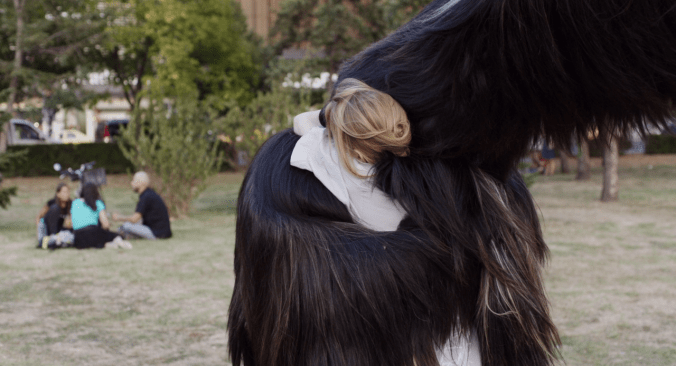
The image above defines this decade in film for me. From the moment I witnessed it in the theater, I never stopped thinking about it. Later on I saw that the producers used the image on their poster. In some instances a moment so late in a film could be a spoiler, but this image is too perfect to be spoiled. A confusing silhouette: a giant monster covered in long black hair embraces a small woman in white, her blonde hair tied up behind her head in a spiral, small wisps of it starting to unravel and fall to her shoulders, her arm clutches tightly around his neck, almost disappearing into his mass of black hair. Order and Chaos. The moment is silent. It happens quickly and is over just as fast. In a single image, Maren Ade has given me the thing I’ve been searching for in every film for the last 17 years. A single, perfect expression of love.


 Crossing Borders