VIFF 2024 Review – The Heirloom

My past few years of screening for VIFF and Fantasia have afforded me some pretty exciting sneak previews of upcoming indie films, but rarely am I as excited to watch something as I was when Ben Petrie’s The Heirloom showed up in my inbox back in March. My first experience with Petrie was through his excruciatingly funny 2016 short film Her Friend Adam, which my friend Ryan showed me the first time we sat down to watch movies together, shortly after the COVID lockdown. We met volunteering at the Cinematheque and instantly bonded, becoming great friends and writing partners. Years later he accompanied my wife and me to Montreal for Fantasia, where we saw Grace Glowicki (Petrie’s partner and co-star of The Heirloom) in Mary Dauterman’s hilarious, gross-out, cat movie Booger. I was hooked after circling back to Glowicki’s wild first feature Tito.

Alongside making a new friend, the time in quarantine brought along new pet projects. I took up brewing premium coffee and spent more time writing, leading to new employment opportunities in third-wave coffee and festival programming. The Heirloom begins with a similar jumping-off point as we meet Eric and Allie, stuck inside and with too much time on their hands. Eric fills the days working on a screenplay but seems to spend much of his writing time with his pants down and the close-all-tabs hotkey at the ready. Allie is bored out of her mind and has her heart set on getting a dog. Her early attempts to discuss pet adoption with Eric are met with convoluted ethical debates and scheduling issues. The comedic chemistry in these early scenes highlights the gap between Ben’s neurotic, high-strung Eric and Grace’s carefree Allie. 

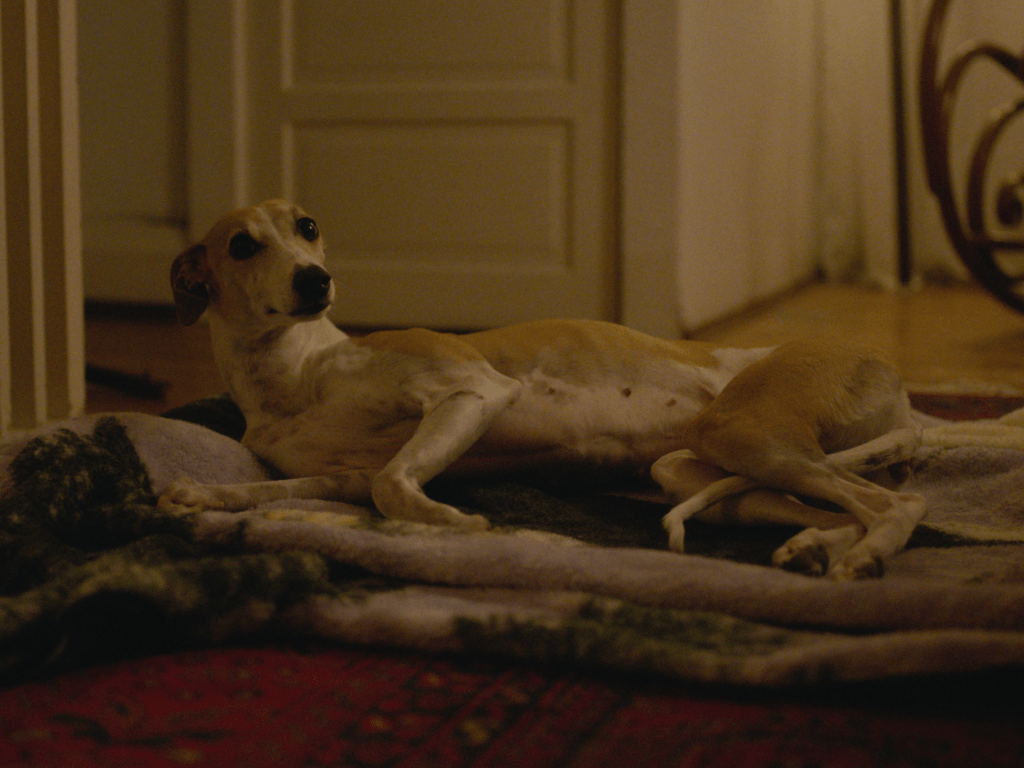
Eric finally agrees to adopt but on his terms. His detailed research and planning lead the couple to a traumatized rescue dog from the Dominican Republic. They follow Eric’s plan to the letter, avoiding eye contact and talking when they pick up the dog from the airport, hoping that presenting a calm demeanour will help the new arrival warm to its surroundings. They name the dog Milly and eventually, she opens up to the couple, though her new diet (Eric is vegan) doesn’t seem to agree with her stomach. One night, while making a home movie about his pet and his partner, Eric is hit with a flash of inspiration and decides to scrap his screenplay and refocus on making a movie about Grace and him raising their dog.

This is when things get interesting as The Heirloom evolves from a hilarious screwball comedy about a couple in isolation and their dog into a deeply personal and metafictional piece that blurs the lines between fiction and reality. Trapped between two versions of himself (A self-described workaholic and family man) Eric’s film takes over the proceedings, giving us multiple retakes of moments that had come before. Milly’s gastrointestinal issues get worse and the pair stress over her bowel movements and frequent trips to the vet. Structurally, the film unravels, as the couple drifts further apart, and we are often left wondering if what we are watching is real or “acting,” but what better way to dramatize such a cataclysmically surreal experience as the lockdown?

Months after seeing The Heirloom, my wife and I adopted a cat. I revisited the film a few weeks later while writing about it for the VIFF program and saw it echoing through my own recent experiences. Not only had I taken on Eric’s obsessively detailed and controlling approach to pet training, but we also found ourselves strangely obsessed with our cat’s bowel movements. The day our little furball Katsuo finally parked herself in her litter box and had her first poop was the highlight of the summer.


I’m full of excitement this morning, as I feed my cat her breakfast and get myself ready for day 1 of VIFF. On day 3 (Saturday Sept 28th) I’ll have the privilege of moderating a Q&A for The Heirloom with Ben Petrie at The Cinematheque. Having my first Q&A at my favourite theatre in the city with a director I admire is a priceless experience and I’m eager to share it with everyone. Get tickets to The Heirloom HERE.

VIFF 2023 – PRE-FEST REVIEWS II

VIFF 2023 starts tomorrow and I wanted to follow up my documentary reviews with a couple narrative films that I had the honour of pre-screening for the festival.

WHEN ADAM CHANGES – JOËL VAUDREUIL

Adam is a 15-year-old boy with a strange condition that causes his body to change based on the negative comments of other people. This all starts with his hateful grandmother who never misses a chance to comment on Adams’s weight or his “long torso.” The film opens in the hospital, and Adam’s family is gathered around Grandma’s death bed when she sits up, scans the people in the room, sees Adam, and says, “I always said that boy had a long torso,” before she keels over and dies. Her last words. Adam’s torso, already bent, long, and uncomfortable-looking, stretches a bit more.

What follows is a delightful, off-beat coming-of-age story about the power of words and the pain of growing up different in 90s Quebec, all told through janky, hand-drawn cartoons reminiscent of the same era’s MTV Animation style. Full of cringe-inducing nostalgia and awkward teenage confusion, When Adam Changes is a surprising and hilarious film that had me laughing and crying in equal measure.

Following Adam through his summer break, we witness him nervously navigating the horrors of adolescence. He gets a summer job looking after his father’s boss’ home, while their family is away on vacation. The young rich boy of the house takes him on a lazy tour, showing him all the cool stuff he owns and reminding Adam that he’s not allowed to touch any of it. He’s mostly left to clean the house and tend to the limbless cat, who spends her days carefully propped between her litter box and food bowl. He sneaks peeks at a dirty magazine he finds wedged between the rich kid’s mattress and fixates on a particular photo that reminds him of his crush, the most popular girl at school.

It’s all an embarrassing mess and it’s also painfully relatable. Adam is wracked with guilt over an experience he had with a younger, neighbourhood boy that ended with the boy getting severely injured. Now with a permanent, disfigured grin, the young boy wordlessly roams the streets at night, a long metal pole in his hand, scraping on the sidewalk, a constant reminder that haunts Adam. There’s also the question of who keeps throwing bags of dog droppings into the trees across the street…

Somehow director Vaudreuil manages to tie all these bizarre, silly ideas together into something that’s both hilarious and profound. The grotesque aesthetic and the deadpan voice acting perfectly fit together to match the extreme ends of banality and horror in the teenage experience. When Adam Changes is a one-of-a-kind debut from a Canadian animator that I hope to see much more from in the future. I was completely floored from the moment I saw this film and I’m so excited to have a chance to talk about it with people, now that it’s been released.

I DON’T KNOW WHO YOU ARE – M.H. MURRAY

Benjamin is a queer, black man who lives in Toronto and makes ends meet by teaching private music lessons in his home. After a night out with friends, he meets a man on his way home and things escalate quickly, as he is sexually assaulted and left bleeding in the streets. The next morning, wracked with grief, he tells his best friend what happened and she suggests he get some HIV-preventative medicine.

We follow Benjamin as he tries to acquire PEP treatment at a clinic, having to answer uncomfortable questions and racist comments, he finds himself at a dead end when the expensive meds are too much for him to buy from the pharmacy. The rest of the day Benjamin does what he can to scrape together the money he needs and slowly resorts to more desperate and embarrassing measures, all while pushing back against a broken system.

Intense and urgent, I Don’t Know Who You Are explores barriers to access to medicine and the paranoia, fear, and mistreatment that victims of sexual assault have to deal with in the days following their trauma. There is a risk in exploring such heavy themes that this film could come off as trauma porn, but director M. H. Murray incorporates soft, delicate cinematography and a strong ensemble cast that resonates warmth and love throughout. In the end, we are left with a calm and forgiving experience that doesn’t pull any punches or offer any easy-outs yet offers a possibility of hope and grace.

This was one of the first films I screened for VIFF this year and set the bar very high for every Canadian feature that I’ve watched since.

VIFF 2023 – PRE-FEST REVIEWS

The 2023 edition of the Vancouver International Film Festival is almost upon us! I’ve been wrestling with the schedule trying to fit in all of the films I’m hoping to see. Luckily for me, this year I have much more free time than last, so I hope to see many more films and write more reviews.

This year is a bit different for me, as on top of this being my 4th year with Media accreditation, this also marks my first year on the VIFF screening committee. I’ve been screening films for the Fantasia Film Festival in Montreal for a few years, also and this basically means I watch A LOT of screeners throughout the year to help the festival programmers narrow down their selection.

Of the eighty or so publicly submitted screeners I watched, a whopping 5 were selected for screening at this edition of VIFF, so this year, instead of my usual fest preview of films I’m hoping to see, I’m going to post a few reviews of the selected films that I happened to love. Today I’ll start with a couple Canadian documentaries.

MR. DRESSUP: THE MAGIC OF MAKE-BELIEVEROBERT McCALLUM

I was quite surprised when this film showed up in my inbox. Produced by Amazon Canada, this doc feels like the type of film that shoots its way straight up to the VIFF Special Presentations section and is a bit of a no-brainer given the subject. Ernie Coombs A.K.A. Mr. Dressup was a national treasure and his 30-year run on Canadian children’s television was hugely influential on generations of Canadian kids.

As a child of the 90s, I grew up watching Mr. Dressup and even aged out of his content by the time he retired from the screen in 1996. It never ceased to amaze me that the man I grew up watching was the same guy entertaining my parents, decades earlier when they were kids in the late 60s.

The Magic of Make-Believe follows Coombs from his early years as a puppeteer who joined Fred Rogers when he moved to Canada to start a TV series for kids on the CBC. Rogers found quick success and moved back to the States to continue what he started and Ernie Coombs was left to start a spin-off series named after a character he had been playing on the Mr. Rogers show: Mr. Dressup. Powered by a tickle trunk full of costumes, a cast of friendly puppets, and his imagination, Mr. Dressup went on to capture the minds of Canadian children for three decades.

The documentary itself is a straightforward and easy-to-watch story about an artist who wanted nothing more than to positively influence the younger generations. We hear stories about his work ethic, his philosophy, and the way he prioritized teaching children above all else. Former collaborators, friends, and family comment on his legacy and his uncompromising approach to his work. Coombs had his fair share of hardships later in life and we see how the tragic loss of his wife affected him in his retirement years.

In the end, we are left with an affecting and heartfelt portrait of a man who gave his life to teaching children how to be more generous, more kind, and more loving. His legacy is cemented in the hearts of millions of Canadians and is sorely missed in today’s mode of children’s programming.

UNION STREET – JAMILA POMEROY

Union Street explores the history of Vancouver’s black community and the systemic erasure of a culture from the Strathcona neighbourhood in Vancouver’s East Side. Once a vibrant community of African Canadians, the neighbourhood was displaced upon the construction of the Georgia Viaduct right through the middle of the area. Union Street reveals a story of racism in Vancouver that is rarely talked about in the local history books.

I work in Strathcona and often see Union Street director Jamila Pomeroy, as she is a regular at my workplace. Her film is an informative documentary about the black experience in Vancouver, as well as a resounding celebration of black joy and black entrepreneurship. Union Street serves as a positive and educational piece about social justice that invites the audience to engage with and recognize the importance of black identity and cultural diversity in Vancouver.

The film is structured as a series of portraits of members of Vancouver’s black community. Entrepreneurs, artists, musicians, and designers; the subjects are varied and offer unique insight on their experiences, but they share a similar hardship as African Canadians in a city that doesn’t support them.

This also serves as a personal documentary, as Jamila turns the camera onto her father, a Kenyan immigrant who tells his tale of coming to Canada as a young, black man. Not only is he incredibly charming, but his story of arriving in Canada and dedicating himself to helping other African immigrants find their place and integrate is exemplary of the kind of understanding that this film asks of us.

A graceful and illuminative film about the importance of cultural spaces and identity in Vancouver. A celebratory call to arms that asks us to consider the spaces we live in and the people who live there. Gorgeous from the opening shot. The golden, sun-bathed streets and the bright, smiling faces of our beautiful city.

“Today is the day to celebrate our differences.”