My Top 20 Films – 2010 – 2019 – #15-11

15

15 – Mountains May Depart – Jia Zhang-Ke – 2015 – China

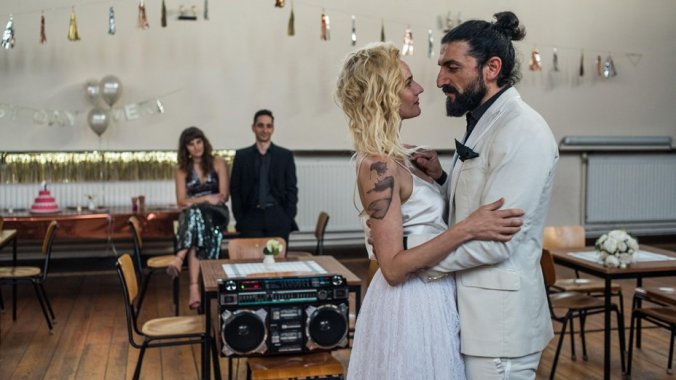
Here we have another film that serves as a placeholder for a filmmaker’s entire decade of output. The 2010’s, for me, at times can best be defined by the effect that seeing the films of Jia Zhang-Ke has had on me. I have mentioned once earlier about my infatuation with “Taiwanese New Cinema” and this is by way of the films of Jia. I struggled to choose a favourite from Jia’s 2010 output. While A Touch of Sin was my entry point and Ash is Purest White may be his best film of the decade, for me Mountains May Depart was the one that hit hardest. Maybe it’s the epic narrative that spans 26 years starting in 1999. Perhaps it is the look at the effects of globalization through the lens of the emotional distance for the members of a family. Here is a film that fails somewhat in it’s ambition, yet touches me to my core. Why? Because I’m a sucker for movies where people dance.

Many of the themes explored in Mountains May Depart will be familiar to viewers of Jia’s other work. Language barriers, familial estrangement and the erosion of a culture through time and corruption. Many of these themes will show up again as my list continues. Culture and borders has become a large aspect of my life this decade. I met my wife in 2012 and from that moment language became a huge aspect of my life. Cultural barriers and race was present where they weren’t necessarily, before. Shino is from Japan and through getting to know her, living with her family and learning her language and her culture, my entire perspective shifted. Suddenly more than ever before, distance was a constant hurdle in my life. At times because of visa regulations, we lived in separate countries, at times we’ve been in the same room and have had no way to effectively communicate. I see culture, now as a daily aspect of my life, an experience I gain so much from.

Mountains May Depart explores a similar relationship in the form of a mother and her estranged son. Their cultures and world view are so divergent, but we are left with the hope that this gap could eventually be closed. Jia doesn’t go so far as to show that moment happening, but in stead chooses to revisit the opening shot of the film where the protagonist Tao (Played by the director’s wife and constant collaborator Zhao Tao) dances to the Pet Shop Boy’s “Go West.” The image of her, now an elderly woman, full of life’s regrets, weeping and dancing in the snow in front of an ancient pagoda smashes through decades worth of cultural barriers. I was personally shattered.

14.jpg

14 – Moonlight – Barry Jenkins – 2016 – USA

Here is the only film of the decade to win the Oscar for Best Picture that will appear on this list. I generally go into the awards season full of apprehension as all my favourite films are crushed by the same overwrought trash from the same overplayed directors. It didn’t go down the way that Best Picture’s usually do (and should) and in spite of the way the scandal affected Moonlight’s time in the spotlight, the reversal of the Best Picture from La La Land to Moonlight is the most enjoyable moment I’ve ever had watching an awards ceremony. If you have access to the video that was shot that night at my friend’s Oscar party, where in real time the award was given, taken away and finally placed in the rightful hands of Barry Jenkins and co, then you know just how happy I was.

All that bullshit aside, I was devastated by Moonlight on first viewing. The structure was the first thing that struck me. Three defining moments at very different times in a young man’s life. There is an inevitability to much of the film. A sense that this cannot end well. As the boy grows up in impossible surroundings and tries to deal with and accept himself as somebody who does not and cannot fit in, it starts to feel like a happy ending is out of reach. I found the film’s final act to be both a touching, soft look at those barriers breaking, but also a sad realization that it will take more than one choice, one experience to break through the conditioning that comes with being a man in a man’s world.

I have had conversations with a friend who did not find this film to go where it needed to go in terms of it’s intimacy. He expressed feeling hurt by the film’s fear of male sexuality and the treatment of the gay experience. I appreciate his point of view, but for me I didn’t see this film so much as being about homosexuality. Though that was a large theme, I think it was partly used to express something about toxic masculinity and the cycle of violence that it produces, particularly in the African American population. I saw Little as a tragic product of his environment. Not taught enough how to love, taught too often how to fight. That we don’t get to see him completely blossom is not necessarily a flaw, because what does happen opens the door to an entire universe of possibility without having to pin it down to one moment or one experience. I left Moonlight feeling thankful for my loving, accepting family and the open, caring environment that I’ve been lucky enough to live in.

13.jpg

13 – Phoenix – Christian Petzold – 2014 – Germany

I have trouble talking about how much I love Phoenix without mentioning the way it ends. I actually don’t know a huge amount of people who have had the chance to see this film, so I will continue to refrain from doing so, other than to say that this film lands on perhaps the most perfect note of any film this decade. I sat dumbfounded as what I already knew to be true was laid out before me in such a powerful and elegant manner and as the credits rolled, I found myself completely paralyzed. This feeling has never fully gone away.

Phoenix follows Nelly (Nina Hoss), a Jewish lounge singer who survives Auschwitz and returns to Berlin and receives facial reconstruction surgery to repair a gunshot wound. The doctor is unable to make her look the same as she used to, but she is otherwise very beautiful. She reunites with her husband, who does not recognize her, but sees a similarity in her to his supposed late wife. Her husband convinces her to pretend to be his late wife (Herself… I hope I’m not confusing this too much) so that she can collect a large inheritance owed to her.

Petzold excels at this type of historical, cross-genre dramas. His work with Hoss has produced many lovely films and Phoenix may be their strongest collaboration. He has a certain knack of effortlessly playing out the twisty, turny plot with all it’s secrets and reveals and never losing a string or letting the main objective get out of sight. When he finally ties the whole thing up, it’s a delicate, powerful moment of silence, rather than a bang that left me doubled over in emotion.

12

12 – Good Time – Josh and Benny Safdie – 2017 – USA

Alright, let’s get crazy.

If you haven’t seen Good Time and I’ve told you that you should, then what the hell are you waiting for. If you haven’t seen Good Time and I haven’t told you to, then now you’ve been served, get the fuck out there and watch this crazy movie. If not for yourself, then for me.

This aptly named thriller from the Safdie Brothers is a non-stop ride through the chaos of one man’s night on the streets of New York City trying to break his developmentally disabled brother out of jail. There is an energy to this film that bores it’s way into your brain. The buzzing score (Oneohtrix Point Never) and jarring camera work give a sickening feeling of unease and Robert Pattinson’s best performance to date helps to ground this madness, while keeping you riding the edge of your seat.

Fun. Non-stop craziness. There’s a plastic bottle full of liquid LSD, introduced in the best cinematic tangent I’ve ever seen. Good Time is the best example of a low stakes thriller. This kind of slacker cinema usually comes with lazy visuals and a half cooked plot. The Safdie Brothers Never. Let. Up. Good Time is a shot of adrenaline straight to your heart. Good Time isn’t about right or wrong. It is a frenetic nightmare odyssey through New York City that refuses to slow down. When the end finally comes, it lands with such a beautiful and thoughtful grace note, that I can’t help but feel compelled to start the movie again as soon as the credits finish rolling.

11.png

11 – Mad Max: Fury Road – 2015 – USA-Australia

It’s very rare that a film that forgoes emotional depth for visceral thrills wins me over. More often than not I find myself yawning at spectacle films, checking my watch and counting the minutes till the obvious signals that it’s about to end. It’s not that I hate big budgets or special effects, but more often than not they serve to distance me as a viewer, rather than bring me in on the action. Mad Max: Fury Road is the antidote to that problem.

I saw this in an empty theater in Japan with my wife and mother in law. We sat in the third row, but my mother in law chose to sit near the back. I had heard the hype at this point, of course, but had no relationship with the original trilogy of films and was admittedly skeptical. There are times where my skepticism completely poisons a viewing experience, even minutes in, but minutes into Fury Road I had already been slapped upside the head and halfway down my row so many times, I couldn’t count. My wife asked me to stop screaming at the screen. There wasn’t anybody in the theatre, so I didn’t see what the big deal was, but I swear I did my best to stay quiet. Luckily the low end in the soundtrack washed out my constant excited giggling.

Pure visual storytelling. A keen spatial sense. Constant reinvention and a self awareness and understanding of genre trappings and how to subvert expectations. Mad Max: Fury Road is a master class in action film making. This movie will be the bible for the next generation of action directors. The stunts, the effects, the sound all serve the plot and sequencing of the movie.

I’m not gonna lie. This movie is a big silly mess when you break it down into parts. It’s all kinds of too much and as we go through the second half of this list, you’ll really start to see a theme of “Less is More” Before this decade I was much more inclined to feel that I couldn’t get enough “More” and as I progress through my 30’s and find new things to appreciate in life, I’m noticing that I get much more out of the minutiae of every day than I do a balls to the wall thrill ride. Mad Max walks around like it has something important to say and I think the message is mostly empty and dumb, but I appreciate that it doesn’t waste more than a few percent of it’s screen time trying to say it and rather focuses it’s time doing what it does best. High octane and tons of fun without lowering itself for the sake of appeal. I would go to the big box theaters much more often if the marquee movies were more like this.
[20 – 16] [10 – 6] [ 5 – 1 ]

My Top 20 Films – 2010 – 2019 – #20 -16

20

20 – Stranger by the Lake – Alain Guiraudie – 2013 – France

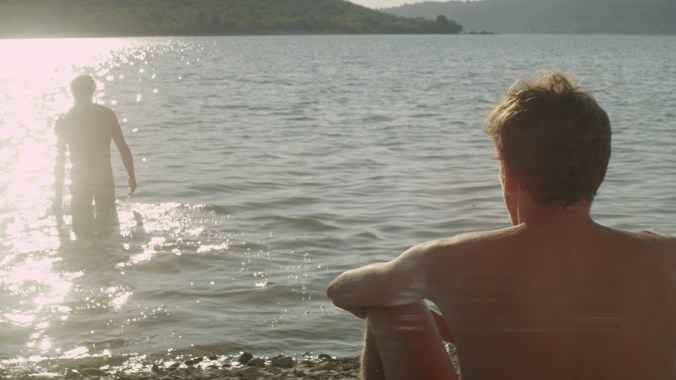
When this film was released, I had heard about the infamous sex scene depicting unsimulated sex between two men. Early in my relationship with my wife, I decided to take her to see this. I think at the time, I wanted to gauge her reaction to something that I knew she hadn’t seen before. I didn’t anticipate that the film would get under my skin in such a powerful way and leave me considering it years later.

Franck frequents a nude beach in France. The beach and surrounding woods serve as a popular area for gay men to meet and hook up. Eventually he meets Michel and is instantly infatuated. He takes to watching the man and his lover and one evening witnesses Michel drowning the other man in the lake. This moment does nothing to lessen Francks attraction to Michel and he continues to pursue him despite the inherent danger.

A sexy and slow-burning thriller that uses suggestion to explore uncertainty and fear that comes along with being a sexually active gay man. We know Franck is aware of the risks he takes pursuing Michel, but the film does him the service of never questioning what force drives him towards this danger, but rather that it is a force and it is irresistible. When the intimate scene finally arrives, the stakes are so high and the tension so tightly wired, there isn’t a single moment of it that feels gratuitous or pornographic. This was one of those films I grew to love as the years went on for what it manages to say while attempting to say so little. Queer cinema to the bone, lacking in exploitation or melodrama.

19

19 – Tangerine – Sean Baker – 2015 – USA

If you heard about Tangerine when it was making the festival rounds, you likely would have heard about how it was shot on an iPhone on a shoestring budget, or perhaps that it started two transgendered actresses in their first roles. I wasn’t sure what to expect going in, but within seconds I was arrested by the incredible energy. Tangerine plays out to such a fast paced, chaotic rhythm, that makes it impossible to look away. More of a roller coaster than a train wreck, we follow Sin-Dee Rella on her first day out from a 4 week prison sentence. She meets up with her friend Alexandra and the two embark on a quest around blazing hot Hollywood to catch Sin-Dee’s pimp/boyfriend cheating on her.

The 2010’s have been full of conversations about inclusivity in Hollywood films. With Tangerine, Sean Baker completely blows this debate up by casting two non-professional actresses who deliver an energy and authenticity to their performances and avoid descending into caricature. Somehow Tangerine manages to be endlessly engaging, funny and breathtaking without trying to make some clean cut statement about it’s subject or to wrap things up to make things palatable for a wider audience, yet what is most stunning about Tangerine is its warm heart. For a film that starts at such a breakneck speed, the most significant moment comes when things finally stop and, in a late night laundromat, our heroes come together in silence and the act of sharing a wig seems to close a divide that Hollywood would rather pretend doesn’t exist. An authentic and valid experience that needs to be seen.


18

18 – Spring Breakers – Harmony Korine – 2012 – USA

I know as many people who hate this movie as I know people who love this movie. I came into this a considerable fan of Korine’s work. I grew up with Kids. His directorial debut Gummo was an early instance of me dealing with a piece that upset me so much it made me angry. Over time, I grew to love Gummo and appreciate it as the hilarious shockstravaganza that it is. By the time Spring Breakers was announced, with the Mickey Mouse Club cast and the day-glo, Girls Gone Wild aesthetic, I knew this would be more than it appeared on the surface.

Shino and I saw Spring Breakers on opening night in a theater packed with teenagers. I snickered in private, thinking that these kids had no idea what they were getting themselves into. In reality, Korine gave them exactly what they came for. Tits, Dubstep, Booze, Guns, Drugs, Numchuks (sp) and James Franco doing a pitch perfect impression of dirtbag Texas rapper Riff Raff. Is there something deeper being said here about a generation dedicated to empty, mindless partying? Probably, but more than every other film on this list, Spring Breakers appeals to me because it is unapologetic, senseless, remorseless fun. Rather than pointing his finger and looking down at the youth of this decade, Harmony Korine rips his shirt off and stage dives directly into the mosh pit.

Harmony Korine is incredibly gifted in the art of Idiot Poetry. He co-opts the worst elements and vocabulary of a subculture and spits it back at us in a way that heightens it; in a way that makes it profound. There’s something to be said about a film that has me giggling with excitement over a monologue about drugs, money, guns and shorts and moments later has me tearing up to a Britney Spears song replete with a machine gun ballet and pink ski-masks. I refuse to sell this film short. When people raise their eyebrows at my mentioning Spring Breakers I am only inspired to double down and explain in the most grand of statements just why I believe this is a defining work of this decade. Spring Breakers is the distilled essence of what it meant to be young and dumb in the early 2010s. I have and will continue to revisit many times.

17

17 – An Elephant Sitting Still – Hu Bo – China – 2018

A work of such incredible scope and despair, it is impossible to talk about it without bringing up the tragedy that we will never receive a follow-up, as the director commited suicide shortly after completing this, his debut feature film. That this element is usually front loaded in the press for the movie is no surprise, as it serves to set the table for the type of experience that watching An Elephant Sitting Still can be.

There are few films in the history of cinema that so precisely inform a feeling of hopelessness as this one. On top of that, the film is 4 hours long. There isn’t a moment in the entire running time of An Elephant Sitting Still that offers an olive branch or even a fractal of light to pour through the cracks. We follow the four main characters on their descent into desperation and watch as they give up under the oppression of their circumstances. The setting of Manzhouli in Norther China serves as an impossible hurdle in the way of the protagonists. An old man being offloaded by his children, a younger man wracked with guilt over the suicide of his friend, a teen boy trying to escape an endless cycle of bullying and a teenage girl who leaves home and begins a relationship with an official at her school.

This film could not have been made anywhere other than China. The difficulties involved to produce a piece like this and the kind of environment that is required to create this world view are perfectly in line with the kind of isolation that is so commonplace there. Chinese film has become one of the most important sections of cinema for me in the past decade. Through some of the greater examples from the “6th Generation” of Chinese cinema, I have discovered the masters of “New Taiwanese Cinema” and a beautiful new film language that speaks to me in a way I hadn’t previously experienced. In many ways An Elephant Sitting Still shares ground with some of those other examples of great Chinese Language Cinema. It also stands on it’s own as the most upsetting portrait of social despair that has ever been made.

I know it’s a lot to ask you to watch a depressing 4 hour Chinese movie. The final thing I will note about this film is that it flies by at a terrific pace. There are few moments to contemplate what has just happened before another card is balanced on top and before you know it, the whole thing gives way. Groundbreaking and final. The work of a Master who was not to be.

16

16 – The Lobster – Yorgos Lanthimos – 2015 – UK

This marks the first film in this list that was in conflict with another film by the same director. Even as writing this, I m not sure why I would choose this over 2018’s The Favourite. The Lobster was in many ways my favourite film of 2015, but it is not the highest ranked on this list from that year, either. I remember back to 2009 when I saw Lanthimos’ second feature Dogtooth and it was instantly apparent that I had witnessed the work of somebody who would go onto do something truly spectacular. I didn’t realize just how far that would go on to be true, until learning that he was set to produce his first English language film with a flawless who’s-who cast and a considerable amount of foreign money. Now the question was would the Greek guy be able to translate his particular film language into something that would work in English and would the budget enable him to achieve his vision or get in the way of it? Many filmmakers have made this transition only to flee back to their home countries to rework their new skills into a more succinct and effective piece in their native language (Bong Joon-ho, Park Chan-Wook, Florian Henckel von Donnersmarck all spring to mind). With The Lobster, Yorgos Lanthimos makes the case that film transcends spoken language and speaks to universal truths without losing what makes his films distinctly greek.

A fable about a man who goes to a hotel after his wife leaves him for someone else. He lives in a world where being single is not an option and is given 45 days to find a new mate or he will be turned into an animal of his choosing. He chooses a Lobster because they live long, fertile lives and he has a love for the sea. The conditions at the hotel aren’t exactly optimal for nurturing a romantic relationship, and the people in this world are so disassociated that they see things like mutual constant nosebleeds to be a signal that the two should mate. The fact that one of these people secretly smashes their own nose doesnt feel sad, but necessary. When love shows up, it is practical, and unromantic and yet by the end of the film seems like something worth sacrificing everything for.

Lanthimos’ trademark wooden, to-the-point dialogue is a treat to listen to. He has gone on to make two more English films. The Killing of a Sacred Deer, which I love, in spite of it’s ridiculousness and The Favourite, which is Lanthimos at his best. Where that film grounds itself in history and three incredible performances, I chose to place The Lobster here, in stead, because I think it is a better representation of what makes Yorgos’ films so much fun to watch. I think The Favourite is a better movie, but The Lobster lays the groundwork and has set the stage for so many more wildly inventive films to come.


[15 – 11]    [10 – 6]    [5 – 1]


VIFF 2019 Review – The Body Remembers When the World Broke Open

201910615_6_IMG_FIX_700x700

Those who have read my reviews over the years have probably noticed the complete lack of commentary on English-language Canadian cinema. For the majority of my life, cinema has served as a lens into other places and cultures. I even weigh my affinity for other places almost completely on the output of their filmmakers. Canadian films should be easy for me to relate to, but generally come off feeling more foreign to my experience than anything from outside North America. Afraid to upset, upend or stand out at all, the films of my country come off as polite and inauthentic in an misguided reach for profit. The money isn’t there and when it is, the hollowness is obvious. I named my review blog Crossing Borders specifically for this reason, as a Canadian cineaste, I have rarely had a film experience that made me proud of the country I was born in. Today that has completely changed.

The Body Remembers When the World Broke Open by Elle-Máijá Apiniskim Tailfeathers and Kathleen Hepburn is an astonishing and groundbreaking work of art that extends beyond the boundaries of our humble country and speaks to universal themes of heritage, womanhood, class and displacement. The journey of two indigenous woman across the rainswept streets of Vancouver’s Downtown East-Side plays out in a single breath-taking sequence (Actually 13 sequences stitched together to give the illusion of a single real-time shot) and manages to be both an exhilarating experience and a deeply humanistic portrait of a group of people that is in desperate need of an honest portrayal in film.

Rosie (Violet Nelson) sits near the front of a downtown bus as Áila (Writer and co-director Tailfeathers) enters and makes her way towards the back. We follow Rosie home where she lives with her boyfriend and his mother. It is clear her home is a place of unrest, as we catch a brief glance of her partner and hear his angry yelling from the living room. Rosie holds her pregnant belly and quietly waits for things to blow over. Meanwhile we return to Áila in a doctor’s office. The intimate tone of the film is set as she disrobes in private, hiding her underwear in her folded jeans. The doctor comments that her name sounds Polynesian and seems unconvinced when she informs him that it is Scandinavian. After a brief discussion of her medical history, she is given an IUD.

On her way home Áila comes across Rosie, barefoot and upset, her boyfriend swearing at her from a block away. Panicked, Áila convinces Rosie to come with her and invites her into her home. She gives her some tea and dry clothes. A moment with Áila trying to find appropriate clothes, while trying to calm herself after the disturbing escape highlights the immediate, visible differences between the two women. The sequence inside of Áila’s apartment is tense and cringe-inducing as she struggles to bridge the divide separating them. Áila’s accent changes, she mention’s her grandmother, she tries to relate her own experience of growing up on the Blood Reserves to Rosie’s. The invisible barrier between them holds strong as Áila tries to convince Rosie to go with her to a safe-house and can’t seem to understand her reticence to take any kind of support.

There is a brave statement being made here about privilege. As a visibly indigenous woman, Rosie has experienced a much darker side of the system than Áila, who is of a half Sami and affluent background. Considering this film is based off of Tailfeather’s actual experience, and she plays a heightened version of herself, this is an incredibly brave and honest performance. The clarity and lack of ego bleeds into the entire film. The Body Remembers sits gracefully in a moral gray area. There is a deep felt respect and love for the two women and a complete lack of judgment. Áila offers a lot of advice to Rosie through the film and it is often met with resistance.  She has the best intentions, but is unable to see the affect of her words. A lesser film would resort to caricatures, or perhaps a moment where the unprivileged person puts the other in their place. Instead we are left to hear the echoes of this history without being spoon fed some kind of easy-to-digest moral. The filmmakers ask more questions than they answer, but this happens with the knowledge that it isn’t their responsibility to answer those questions.

I could go on for hours about every scene in this film. A variety of locations and tones rush by in gorgeously shot 16mm with a soft blue tint and splashes of pink, and purple and orange. Violet Nelson’s performance is more genuine and controlled than you could ever expect a first time performer. Generally a director uses context and editing to help the performances of non-actors. Here Violet is asked to perform long sequences of dialogue and movement and she does so with confidence, grace and a natural sense of being. Rosie’s quiet demeanor is accented with a sharp tongue and she is responsible for the film’s most biting lines and warmest moments. Hepburn and Tailfeathers deserve credit for creating a safe and authentic environment where the performance could flourish. 

This film eschews sentimentality and yet managed to leave me completely emotionally shaken. This has to be commended. Rather than manipulating the audience into feeling big emotions, The Body Remembers draws out those emotions through careful attention to detail and a soft, feminine eye. A final exchange in a dark taxi provides a moment of incredible catharsis as the two characters exchange the same compliment. We can barely make out their faces, but the emotional weight of the scene resonates long after the credits have rolled. I’ve had a pit in my stomach all day.

The Body Remembers When the World Broke Open is currently my favourite film of the year and perhaps my favourite Canadian film ever.

Top 20 Films of 2018

2018 was a very strong year for international cinema. Here is a list of my favourite films that were released over the past year. I had 4 films that exceptionally stood out for me this year. I will list my top 4 with descriptions and then 16 more in alphabetical order.

812x1200-v2

  1. Burning – Lee Chang Dong – South Korea
    A slow burn thriller from Korean master Lee Chang Dong. We had to wait 8 years for the follow up to the brilliant Poetry, a film I have recently started calling my favourite film ever. Burning is a dark, murky film full of delicious ambiguity. Based off of a Haruki Murakami short story called “Barn Burning.” An exploration of class, male sexual obsession, creation, destruction and the nature of reality. Burning is so many things at once. Every conversation I’ve had about it has focused on different elements depending on who I talk to. Rarely do we get a film with such a richness of meaning that also holds up as an engrossing and entertaining thriller. The performances by the three main characters are electric and a long take that serves as the centrepiece is without question my favourite shot of the year. Burning is South Korea’s first film to get shortlisted for the Foreign Language Oscar and should be seen by everyone.
    1200px-Shoplifters.png
  2. Shoplifters – Hirokazu Kore-Eda – Japan
    This years Palme D’or winner is an absolutely crowd pleaser. An offbeat Japanese family drama full of empathy and heartache. Kore-Eda is Japan’s greatest living filmmaker and his prolific output is a gift to the world. Shoplifters feels like a culmination of many themes explored in other Kore-Eda films, yet it is fresh and surprising. The cast is superb, especially the child actors, who in typical Kore-Eda fashion are full of life and understanding. Shoplifters offers a window into a darker reality of Japanese culture that goes wholly unchecked in the tradition family film. If you would like to hear more of my thoughts on this beautiful tear-jerker, I suggest reading my review on the previous page of this site. Side note: While searching for the photo I wanted for this review, I may have had a bit of a cry….
    the-favourite-TF_03729_rgb.jpg
  3. The Favourite – Yorgos Lanthimos – UK
    When I found out Lanthimos was making a costume drama, I was a little surprised. Upon seeing a trailer, it was clear that this may be the perfect setting for his off-kilter dialogue and twisted sense of humor. A story of political intrigue in the bedrooms of Queen Anne, as two cousins compete for her affection and trust. The majesty of the setting works in delightful contrast to the dark depths of humanity that Lanthimos so loves to explore. The Favourite is an acerbic, silly and surprisingly emotional satire that features 3 of the best female performances of the year. Olivia Colman shines as Queen Anne, falling back on her history as one of U.K.’s best comedic actresses, her portrayal of the sickly, needy monarch is a crowning achievement in her career. Emma Stone has never been more charming and Rachel Weiss has never been scarier. (Or is it the other way around?) Watching the power game the three women play and trying to decide which of them is the most deserving (or least deserving) of happiness is an absolute Joy. There has never been a movie that has this much fun with deception and manipulation. The Favourite is Lanthimos at the top of his game and breathes life into modern costume dramas. One of the best dark comedies ever.
    climax-2018-1200-1200-675-675-crop-000000
  4. Climax – Gaspar Noe – France
    Now for something completely different. Climax is a visceral, horrific experience and Gaspar Noe’s best film by far. An acid drenched dance movie that puts its foot on your throat and refuses to let up. The amount of anxiety I felt watching this movie makes it hard to recommend to everybody, but for horror aficionados and people who like a wild ride, this is a must. Long, swirling shots that seem to go on forever and take us on a descent into hell. The year’s best soundtrack and most impressive ensemble cast performance. It is rare that such a genre film cracks my top 5, as I generally gravitate to films that employ subtlety to get their point across, but the bludgeoning I received while watching this movie was the most exhiliarting experience I have had in a theatre in years. This is one I’m gonna watch many times just to remind myself of how it feels to be alive. Sexy, scary and thrilling like no film has ever been.

5-20 (In Alphabetical Order)

Ash is Purest White – Jia Zhang-Ke – China
Blackkklansman – Spike Lee – USA
Blindspotting – Carlos Lopez Estrada – USA
Cold War – Paweł Pawlikowski – Poland
The Death of Stalin – Armando Iannucci – UK
Eighth Grade – Bo Burnham – USA
First Reformed – Paul Schrader – USA
Hereditary – Ari Aster – USA

If Beale Street Could Talk – Barry Jenkins – USA
Isle of Dogs – Wes Anderson – USA
Microhabitat – Jeon Go-Woon – Korea
Minding the Gap – Bing Liu – USA
Roma – Alfonso Cuaron – Mexico
Support The Girls – Andrew Bujalski – USA
Western – Valeska Grisebach – Germany
The Wild Pear Tree – Nuri Bilge Ceylan – Turkey

VIFF 2018 – Shoplifters

1048036.jpg-r_1920_1080-f_jpg-q_x-xxyxx

A quick Japanese lesson for everyone.
万引き家族 – Manbiki Kazoku. 万引き – Manbiki means “Shoplifting” – 家族 Kazoku means “Family”

The English name for the new film by Japanese master Hirokazu Kore-Eda gives the impression that the operative word in the Japanese title is Manbiki. This is a lousy translation in my opinion, as shoplifting is a minor detail. In fact, Shoplifters is very much about Family. Not just this family, but family as a concept. What does it mean to be a family unit? What is the origin of that bond? I would have much preferred the English title to be the clunky literal translation Shoplifting Family, I would have even settled for just Family.

Now one could argue that almost all of Kore-Eda’s films are about family. Including his narrative feature debut Maborosi in 1995, Kore-Eda has made 13 films and almost all have centered on some kind of family unit. Shoplifters feels like a culmination of many of the themes explored in those earlier movies. If it weren’t for his deft hand and restraint as a story teller, you could accuse Kore-Eda of retracing his steps. Thankfully this is not the case and what we have here is one of the director’s most important and emotionally resonant films.

Osamu (Poet turned actor Lily Franky) enters a grocery story with his son Shota. We see them methodically stake out the area before Osamu gives the go ahead and Shota shoves snacks into his bag. On the way home they spot a young girl locked outside on her balcony by herself. Hungry and dirty, they offer her some food and eventually end up bringing her home. At home we meet Nobuyo, (Sakura Ando) the mother of the house, Aki (Mayu Matsuoka) a girl in her early 20’s, and the grandma Hatsue (Acting legend Kiki Kirin). It becomes clear that this family is not of the traditional sort and what holds them together is not something as tangible as blood.

At first there is reticence by the family to keep Yuri around. The risk is too great, but when Nobuya accompanies Osamu to Yuri’s home to return her, she overhears the girl’s mother fighting with her boyfriend. The mother says terrible things about her maternal regrets and this turns something in Nobuyo, who immediately retreats home and begins to introduce Yuri to her new family. They change her name to “Rin” and cut her hair, when the girl is reported missing. They buy her new clothes. Rin refuses to let her new mom get her a cute, yellow dress, asking “Are you going to hit me later?” She’s been conditioned to anticipate any moment of kindess to be followed by cruelty and violence. Later Nobuyo notices a scar on Rin’s arm when taking a bath and she shows her own forearm with an identical scar.

Money is hard to come by for this growing family and the tiny space they occupy in the grandmother’s name is barely enough for two people, let alone six. Osamu goes to work as a day labourer, Nobuyo works in a dry cleaner and pockets whatever valuables she finds while on duty, Aki works in a club doing private shows behind a mirror. Between these meager salaries and Hatsue’s pension, they get by. Shota teaches his new sister how to steal things while their parents are at work. They pass a pair of school kids and he tells her “School is for kids who can’t study at home.” The phrase “Work Share” is employed multiple times.

This is a concept that has been done before. This trail has been dug out countless times and a lesser artist would fall right into the grooves. Hirokazu Kore-Eda is not one to take the easiest way out and you can rest assured that if he chooses to take on a typical story, he has good reason. The subtlety and restraint displayed by the director as he guides this complicated family unit through this story is impressive. He refrains from telling us why these people have found eachother and stayed together, and rather focuses on what goes on between them that actually makes them a family.

The acting in this film is outstanding. Lily Franky and Sakura Ando are selfless artists. Free of ego and affectation, they are real people in a real world. Ando is particularly impressive in this role. A long time favourite actress of mine, she is beautiful, but has no qualms with looking ugly. Later in the film she questions, through tears, the inherent instincts and love that are expected of mothers in a devastating scene that hits the nail on the head. Lily Franky is terrific as always. Full of empathy and sadness, his clumsy physicality belies his real-life history as a poet and artist. Kiki Kirin is chameleon-like in her patented Oba-chan role. Toothless and mumbling, she is so different from usual that it took my lovely Japanese wife half an hour til she turned to me and asked “IS THAT KIKI KIRIN!?!?”

I cannot stress how much adore the films of Hirokazu Kore-Eda. He has blown life into the Japanese family film without straying into cliche or sentimentality. The fact that he can do it again and again is magnificent. He is in my humble opinion the greatest director of children (A quality I always cite as a sign of a great filmmaker) and this film is no exception. The two children actors navigate some pretty heavy content with sensitivity and understanding. It’s impossible to imagine these kids in their real lives, as Kore-Eda has written and directed them to be two very authentic characters with their own unspoken histories and secrets.

So the question I asked earlier. What is a family? What is the bond that holds these units together? After reading the notes I wrote during this film, one word stands out.

Love.

Love in all it’s selflessness. Free of thought, reason and blood. The delicate familial connections between these characters may come and go, but in the end you know that the 絆 Kizuna (Bond) between the six members is stronger than any thread of DNA could ever be.

VIFF 2018 – Holiday – Diamantino – Climax

Holiday - Still 1

Holiday – Isabella Eklöf

The screening I attended for Danish director Isabella Eklöf’s debut was preceded by two trigger warnings. One from the festival and one from the filmmaker herself. We were informed of the intense sexual violence that was to come. I have since read articles about the scene in question and have seen comparisons to Gaspar Noé’s Irreversible. Holiday certainly features an intense rape scene, but this is not exactly the #metoo movie that I was expecting it to be.

Sascha (Victoria Carmen Sonne) arrives to a beautiful coastal city on the Turkish Riviera. She is picked up by a well dressed acquaintance and driven to her boyfriend’s villa in the hills. On the way she explains that she spent a small amount of money that she had smuggled across the border, (Just 300 Euros out the total 50,000) because her card was declined when trying to purchase a new swimsuit. The driver pulls his car over and carefully explains that this is not okay before slapping her a couple times across the face. This girl has gotten herself into quite a bit of trouble.

Her boyfriend, Michael (Lai Yde) is a mid level druglord who lives in a beautiful villa with an all-Danish family of thugs, blonde women and a couple minors. Once Sascha arrives, it is nothing but smiles as Michael rewards her for a job well done with a trip to a jeweler. They make love, do a bunch of drugs and hit the clubs every night. As Sascha starts to strike up an acquaintance with a handsome Dutch vacationer, Michael’s dark side starts to come out.

Think you’ve seen this one before? You probably haven’t. Eklöf shows a confident, subtle touch as she navigates this touchy subject matter. This is NOT another insipid rape-revenge plot. This isn’t a angry-boyfriend-goes-psycho movie. Holiday is another beast altogether and full of surprises as the plot unfolds. Sonne’s performance as a vapid blonde on vacay is superb, as she makes one bad decision after the next and never seems to learn from them. Could she really be this thoughtless?

Not nearly as vulgar or extreme as we were initially led to believe. I think comparing this film to Irreversible does both Eklöf and Noé a disservice. This is a smart, calculated debut that touches on MUCH MORE than just sexual violence. A delicate, nuanced film that deserves more than the lazy “shock” label that has been forced on it.

diamantino-288303461-large

Diamantino – Gabriel Abrantes & Daniel Schmidt

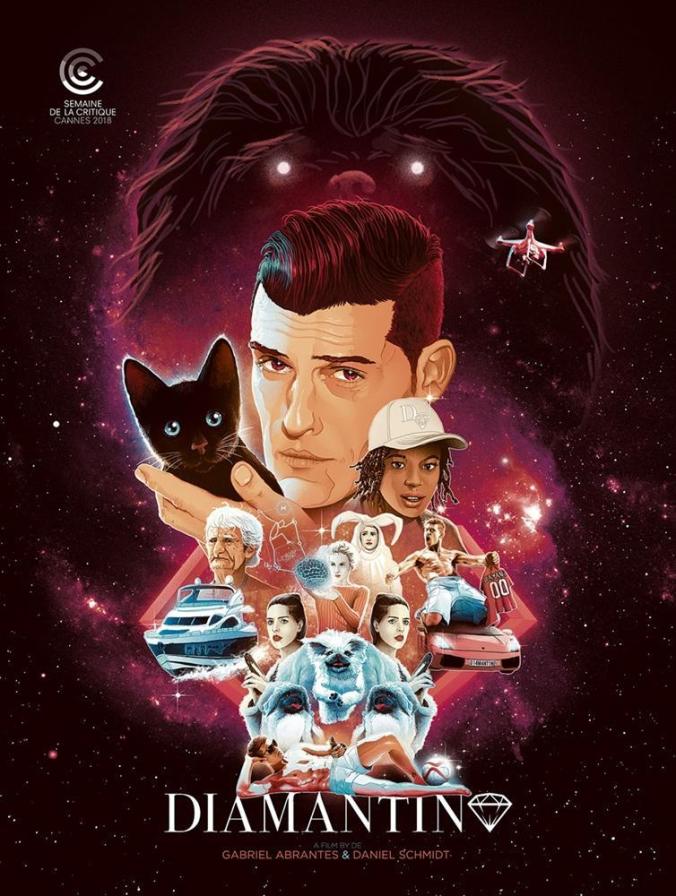
Another debut that opened with a different kind of advisory. We are informed that the film we are about to see is a work of fiction and any resemblance to people, places, products or giant puppies is coincidental. The joke is quickly followed through on as our hero Diamantino (a sort of knock-of Christiano Ronaldo) is playing in the World Cup for Portugal and as he takes the ball and begins to go on a run, we learn the secret to his success. The field, players, crowd all disappear and are replaced with an empty black space, pink smoke and a gang of giant puppies. The superstar proceeds to dribble around these furry creatures and nails a game winning goal.

I don’t have space to explain every plot point, here, nor do I think it would help, as a large part of Diamantino’s charm is trying to keep track of the stream-of-consciousness style plotting. I will say that what follows is a political satire that rips into everything and everyone. MAGA, Brexit, state surveillance, stardom and genetic modification. Just handful of subjects the first time directors choose to chew up and spit out. I’m reminded of some of the more successful seasons of South Park, when the satire was particularly biting and the comedy was just the right amount of absurd.

Carloto Cotta is fantastic as the title character. With the mental capacity and innocence of a 7 year old and an ego only the top footballers in the world could contain, he is completely at will of the forces around him. You can’t help but root for this soft-hearted idiot who falls from super-stardom to meme infamy and rises again to save the nation. A terrifically original film. I will have my eyes out for what this directorial team does next.

climax_still_0HERO

Climax – Gaspar Noé

A woman covered in blood walks through the snow and collapses on the ground. Gyrating and screaming, she carves out a bloody snow angel. In typical Noé fashion, the credits roll over a warbling synth version of a piece by Satie. A few title cards with some classic Noéisms and then a series of interviews with a group of young french dancers. They are asked questions about dance, sex, drugs, heaven and hell. These interview clips play out on a CRT tv screen sandwiched by books on the left side (Kafka, Nietzsche, Wilde) and DVDs on the right (Salo, Suspiria, Harakiri). This prelude presents you with all the information you need to prepare for what follows.
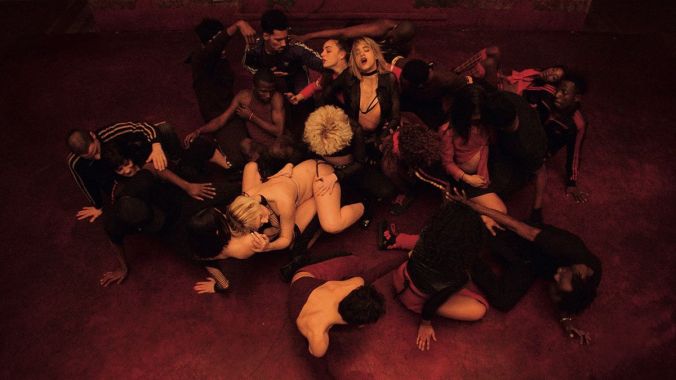
The dancers perform an ecstatic group dance, full of energy, power and sexuality. This is the first of many delicately choreographed one shots, though film goers familiar with Noé’s work can assume that some of these sequences are likely stitched together. The group has reached the end of a long three day rehearsal process and we join them as they are ready to kick back and party before their tour begins. They stand in pairs talking (mostly about sex) and drinking sangria. The soundtrack pumps bass throughout as the cast dances around the neon-lit, former boarding school.
Eventually it becomes apparent that someone has spiked the sangria with LSD and almost everyone in the group starts feeling the effects. A dizzying overhead shot of a group dance off grows in intensity and once they realize something is wrong, it is much, much too late. Panic and anxiety take over as the dancers lose control and the party descends into a harrowing painting of Hell-on-Earth reminiscent of a Hieronymus Bosch painting.
Despite the drugs, Climax is Gaspar Noé’s most enjoyable and coherent film. The camera floats around the claustrophobic setting and keeps track of the range of reactions the dancers have to being drugged. A sober male is tossed out into the cold snowy night, a pregnant woman is driven to madness and a child is locked in a dangerous maintenance closet. Women writhe around on the floor, foaming at the mouth under Noé’s signature strobe lights. Watching Climax is an absolute experience. Perhaps the first musical-horror film that isn’t played for laughs, though a climactic title card reading “Life is a collective impossibility” could be seen as a very Noé-style punchline.
This is certainly Gaspar Noé’s best film. He seems less interested to provoke and is now having a bit of fun, but something tells me this film may be a bit of an anomaly and the positive critical reception may drive the provocateur to create something less palatable in the future.
A kaleidoscopic, LSD-fueled nightmare that depends on the collaboration of some very courageous performers and a technically flawless production crew. With luck, Climax is an indication of what we can expect from Noé as he ages.

VIFF Day 8 – Capsule Reviews

MV5BZWM1MWRhZjQtZjljZC00ZTNmLWI4M2UtMWVmNmUyNjhlYTVhL2ltYWdlXkEyXkFqcGdeQXVyNjI0NTQ2Nw@@._V1_SX1777_CR0,0,1777,744_AL_

Bad Day for the Cut – Ireland – Chris Baugh

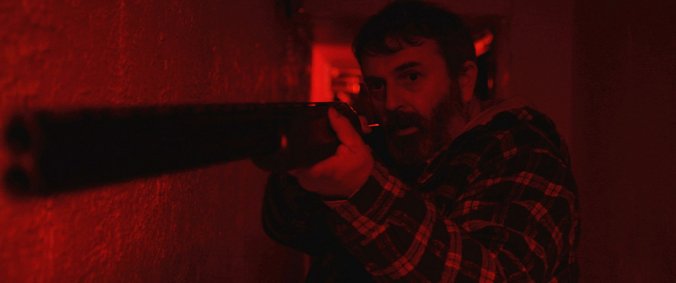
A middle-aged farmer seeks revenge in the feature debut from Chris Baugh. A slow-boil genre film with some brutal instances of violence throughout. The comparisons to Jeremy Saulnier’s Blue Ruin are unavoidable, and while this film doesn’t do anything particularly new, it’s the details that count. Donal’s mother is murdered and when the people responsible send muscle to kill him, he turns the tables and makes his way to the top with the help of one of his attackers. The details behind the murder of his mother and fantastic comedic timing in its action scenes strengthen a sometimes predictable affair. Not sure how accessible this film will be, but a great choice for people who like high tension revenge thrillers.

MV5BYTdlZTMyNTQtODRlZC00OGY0LWFmZTAtZjRmMWUyNTRhMGVlXkEyXkFqcGdeQXVyNTI5MTAyMzU@._V1_

7 Minutes – Italy/Switzerland/France – Michele Placido

A group of women are workers’ representatives at a textile factory that is being sold to a French corporation. If they want to keep their jobs, they have to agree to losing 7 minutes from their 15 minute lunch breaks. The 11 women argue the issue, many of them swaying back and forth. Based on a play that is based on true events, this single space drama is a crowd-pleaser that unfortunately did not work for me. The broadcasted performances, cloying soundtrack and obvious story arc left me feeling cold and disinterested by the close. The characters all take turns explaining their case, each of them hitting on some important issue or subsection in Italian culture. By the time the pregnant woman goes into labour, I was rolling my eyes and checking my clock. That isn’t a spoiler; you can see the plot point coming five minutes in. I can imagine that many people would like this one. The myriad of themes will hit home for somebody.

images-w1400

Good Manners – Brazil – Juliana Rojas, Marco Dutra

Oh maaan! There are so many things to like about this movie! And then there is the second half which falls to pieces and features one of the worst child performances I’ve seen in years. A genre bending werewolf movie with a gorgeous colour palette and some stylistic musical touches that are surprising and delightful. Clara (Isabél Zuaa) is hired as a nanny by the 2-month pregnant Ana (Marjorie Estiano). During a full moon, Clara finds Ana sleepwalking, eyes bright yellow, eating meat out of the fridge. Ana’s bump grows at a high rate and her sleepwalking continues every month. The bond between the woman grows and when the baby is finally born, a particularly gruesome scene, Clara is forced to take up a role as parent to the… child. Along the way we get low-key musical numbers. No dancing, just singing and music. If only there were more of that and less of what comes in the second half as the directors fall into every genre pitfall on the way to what could be a satisfying ending that is marred by lousy CG and badly directed child actors. I always say that the sign of a great director is somebody who can make kids give great performances. Here we have two directors and neither seems to have any idea what to do with this boy. In stead they give him way too much to do and too little help to complete the illusion. I honestly felt bad watching this. So much promise and ambition, but an unfortunate conclusion. Horror fans should check this out for the hilarious and twisted birth scene in the middle.

VIFF 2017 – Day 7 – In The Fade

in_the_fade_2_h_2017.jpg

Diane Kruger won a very deserved Best Actress award at Cannes this year for her role as a woman fighting for justice after losing her family to a terrorist attack. Director, Fatih Akin, tells a somewhat uneven, but ultimately satisfying story of a grieving wife and mother.

The film opens in a prison block. The inmates are out of their cells and cheering. Nuri (Numan Acar) emerges from a cell, dressed in a white tuxedo and is removed from the celebratory crowd and taken to a large room set up for his wedding. Katja (Kreuger) and Nuri get married and we fast forward 6 years. They now have a kid, and Nuri is thriving post rehabilitation. No longer a drug dealer, he helps convicts find their footing when returning to society. One day Katja leaves their son with Nuri at his office to run errands. When she returns, the block is closed off with police tape. She makes her way past a police officer and only gets close enough to see the office has blown up before she is dragged to the pavement and handcuffed.

Akin tells his film in three parts. The first part depicts the immediate aftermath of the attack. Katja is passed through the system and treated unfairly, because of her husband’s past. She descends into a depression; taking whatever drug she can find. It all becomes too much for her, but there is a breakthrough in the case just as she makes the decision to end her life. The second and third parts follow Katja’s crusade for justice against a stone cold pair of Neo-Nazis and I was pleasantly surprised at where the film goes from there.

That isn’t to say that In The Fade is all that surprising, or even original. It really isn’t. Revenge films are a dime a dozen. I must have seen three or four in the first half of the festival. In the Fade is a good example of the revenge film. Akin manages to play directly into the conventions of the genre, but still maintains tension despite the inevitability of the plot. Diane Kreuger’s performance is key here and the main reason the film is elevated above a simple genre flick. Katja’s nihilistic descent in the films first half is absolutely believable solely because Kreuger’s performance is so grounded and honest.

I’m enamored with the closing credits of this film. After an incendiary ending that leaves no stone unturned, the camera spins up into the sky and lands on the water, zooming in slowly, we see the sunlight dance in wisps on the ocean floor. I was mesmerized and watched every second. Stunned and satisfied. A perfect way to close.

VIFF 2017 – Day 6 – Happy End

MV5BMTYzMzgwMzgyMV5BMl5BanBnXkFtZTgwNzI0NzMzMjI@._V1_UY1200_CR126,0,630,1200_AL_

Michael Haneke is one of our greatest living filmmakers. A true master of the form. Two-time Palme D’or winner. What a rush to see him open his newest film with the greatest sin in the history of recorded video: the dreaded vertical video. I’m even hesitant to include the poster I’ve included for this review. The aspect ratio just doesn’t feel right, but Haneke is a master and when he breaks a rule, he breaks it for a reason. The opening sequence made up of four cell phone shots with narration in text from whoever is filming is an absolutely haunting opening that calls back to earlier Haneke films such as Benny’s Video and Cache, but here we are given a modern twist.

The comparisons to earlier Haneke don’t stop there. He is still torturing the bourgeoisie and tearing away at upper-class families and their white guilt. There even seems to be a direct reference to Haneke’s previous film, Amour, almost implying that this is a sequel of sorts. The title implies that you are in for an easier experience than in Amour, but this is a Haneke film and we have to assume the title of the film is somewhat ironic, right? This is the director who made the horrific film Funny Games after all. I won’t spoil the accuracy of the title, but I will say that this is the first Haneke film I’ve seen where the closing credits were met with applause AND laughter.

Happy End follows the Laurent family. Twelve-year old Eve (Fantine Harduin) moves in with her father, Thomas, (Matthieu Kassovitz) after her mom is sent to the hospital from a pill overdose. She is despondent and disconnected and it is obvious she harbours some darkness beneath the surface. Thomas is married and has a new son. When we first see him, it is through the lens of a cellphone and after the opening, it is immediately disquieting. We learn through a series of kinky facebook messages that Thomas is having an affair.

A disaster on a construction site belonging to the family’s firm is found to be caused by neglect and Thomas’ sister, Anne, (Isabelle Huppert) deals with the fallout as the acting CEO. The former boss, their father, Georges (Jean-Louis Trintignant) is now bound to a wheelchair, having given up the reins to his company years before when his wife fell ill. Now widowed, he seems desperate for a way out. It seems he finds his match in the family’s new addition. The performances here are all strong. A scene where Georges tells Eve about the death of her grandmother is a brilliant moment of child acting that calls back to the best scenes in The White Ribbon.

It seems easy to write Happy End off as a retread of Haneke. He explored youth disaffected by media to the point of violence in Benny’s Video (1992), but the update is timely. In the past year we have seen multiple cases of horrible murders, assaults, attacks streamed on social media platforms. Haneke uses these new virtual tools to outstanding effect, building tension and causing unease due to the audience’s familiarity with the platform. I honestly don’t think anyone has presented Facebook live or messenger in such an engaging and cinematic way before. Haneke is 75 and he is fluent in the technological language of modern children.

The plot jumps from time to time, skipping over huge events and Haneke’s sadistic habit of withholding information and emotion continues. There are some lovely surprises near the end, but not where you would be expecting them. The tension builds to a crescendo that never arrives and there would be a feeling of anti-climax if not for a final shot, again with the vertical framing, that puts a lovely, ironic bow on the otherwise bleak experience. This may not be as great as The White Ribbon or as devastating as Amour, but I enjoyed the film very much and look forward to a second viewing.

VIFF Day 5 – The Killing of a Sacred Deer

the-killing-of-a-sacred-deer-1300x799

Yorgos Lanthimos’ new film opens with a disturbing image of open-heart surgery. The tone is set immediately. High pitched strings sound-off sporadically and continue to do so throughout. The Killing of a Sacred Deer is more of a drama than a horror film, but it is impossible to ignore the overwhelming sense of dread.

The past decade has been a difficult one for the debt-ridden Greece. In spite of, or maybe because of this, we have seen a strong group of Greek filmmakers emerge to tell powerful, original stories. Yorgos Lanthimos has stood out from the start. His first feature to reach international screens was 2009’s Dogtooth. His brand of bleak comedy was refreshing. Yorgos asked his actors to do shocking acts and they comply fully. He views them with a cold distance that reminded me of Roy Andersson’s Songs From the Second Floor. 

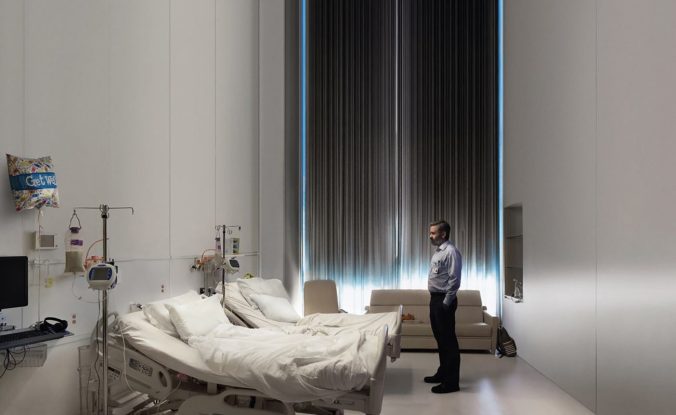
It was clear that Lanthimos was a bold new voice in cinema. The Killing of a Sacred Deer is his second English language film and Lanthimos has changed very little in terms of style. Stephen (Colin Farrell) is a heart surgeon. He speaks in straightforward, matter of fact sentences. The cadence is similar to how Farrell spoke in his previous collaboration with the director The Lobster. In a post-surgery conversation with his anesthesiologist, he asks about his co-workers watch, specifically how many meters the waterproofing will work. He rationally explains why he prefers a metal strap to a leather strap. Small talk is boiled down to something even more inane that real life.

The emotionally stifled world of Lobster seemed to influence the way everyone talks. In Sacred Deer it feels as if his way of speaking has had an influence on the people around him. His wife (Nicole Kidman) speaks in a similar tone. Rather than making rational statements, though, she asks questions. Stripping off her clothes and standing bedside she asks her husband “General anesthesia?” “General anesthesia,” he replies and she lies down on the end of the bed, splaying her arms out above her head. Stephen begins to touch her before we cut back to him walking the halls of the hospital.

Stephen meets many times with a teenage boy named Martin (Barry Keoghan) and they talk. Stephen buys him a watch. Invites him for dinner with his family. The precise reasons why Stephen invites this boy into his home and the outcome once the boy’s presence becomes intrusive are the driving plot points of the film, so I will try not to reveal too much. Stephen’s daughter, Kim, (Raffey Cassidy) develops a crush on Martin. His son, Bob (Sunny Suljic) falls ill and for some inexplicable reason loses the ability to walk. An ultimatum is given with dire consequences. We are faced with an impossible choice.

I hesitate to say too much about this film. Characters in a Lanthimos movie behave in irrational and extreme ways. What seems funny and offbeat at first becomes normalized by the end. The audience laughter through the first act of my sold out screening quieted to a hush of uncomfortable giggles by the end. The banal small talk turns into desperate conversations about life and death; the vocal patterns do not change. One character says outright after a particularly horrible moment, “It’s metaphorical,” and it’s a sadistic wink from the director as you scramble to try and figure out –  A metaphor for what!?

It’s hard to ignore the financial situation in Greece when reading a Lanthimos film. I also wonder if there are references to the bible. The unstoppable nature of the evil the family is up against and the way they seem to accept their fate, as if it was destined, cause me to think there could be supernatural elements involved. Maybe there is no metaphor. Perhaps the highly stylized dialogue is a smokescreen and this world is in fact our world and these are just normal people in a horrible situation.

Strong performances by all the central characters. An incessant feeling of dread throughout. Laugh-out-loud comedic moments and gasp-worthy shocks. The most disgusting spaghetti scene since Gummo. The Killing of a Sacred Deer has it all! This is not a film for everyone. Some people will cringe at the dialogue, fail to take the film seriously and write it off as pretentious trash. For me, I revel in the chance to see something I’ve never seen before. Lanthimos is nothing if not original and this film is a huge step in the right direction. I understand his next film is an historical drama and the first film that he will not be writing himself. I’m extremely curious to see how that will play out. This has been a difficult review to write, my brain has been spinning since I saw this film and I don’t think I’ve done it justice. A Yorgos Lanthimos movie is a beautiful, twisted puzzle and always a treat to try and unpack.