“Your picture is still on my wall – The colours are bright as ever.”
-Daniel Johnston
I started this blog years ago as a way to practice writing, holding myself accountable and to score a “free” VIFF media pass. Over the years, I transitioned to the VIFF screening committee, and eventually became a programming consultant, but maintained this blog to keep myself honest. I’ve watched well over 500 screeners between VIFF and Fantasia in the past 5 years, many of them terrible, some are good, a few are incredible. For me, Sophy Romvari’s Blue Heron stands above them all.
Romvari’s 2020 short film Still Processing explored her grief over the deaths of two older brothers as she sifts through a box of old family photographs and negatives hidden away by her grieving father. As she digitizes the photos, she revisits her memories and begins the process of healing. Blue Heron serves as an expansion upon her previous work, returning to a childhood period of intense emotion and confusion.
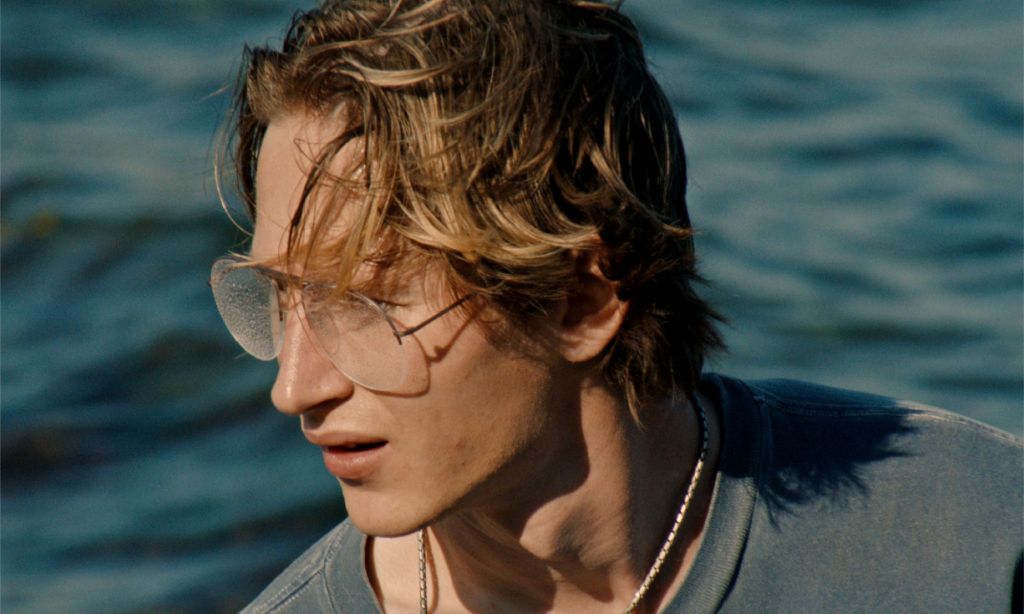
Presented as a memory of eight-year-old Sasha, (Eylul Guven) who arrives on Vancouver Island with her Hungarian immigrant family. Adult Sasha (Amy Zimmer) recalls her eldest brother Jeremy (Edik Beddoes), a “troubled” young man, tall, handsome with eyes full of life behind his thick-lensed glasses – the walls of his room covered with his hand-drawn maps – beautifully detailed, charting imaginary worlds existing inside his head. Quiet, brooding and withdrawn, his parents are at their wit’s end trying to get through to him and the new environment doesn’t seem to be helping matters.
Awash with 90’s nostalgia, we see Sasha and her siblings adjust to their new home over their summer break. Lazy days spent with her brothers watching TV, going to the beach, and playing with MS Paint on her dad’s PC. Her father documents everything with cameras and video recordings, teaching his kids to develop photos in his darkroom and allowing Sasha to play with his camcorder. One day during a water balloon fight with other neighbourhood kids, Sasha witnesses Jeremy arriving at the house in handcuffs after getting caught shoplifting – his behaviour becomes increasingly worrying, and his parents fear he could become a danger to himself and their family. A social service worker arrives to assess the situation and proposes voluntary placement.
We pass through time to meet adult Sasha, who is working on a piece about her brother. She films a roundtable with a group of social workers and shares her brother’s story, asking them how things may be handled differently and what resources could be provided by current day social services. A transcendent BC Ferry voyage takes Sasha back to the Island to reassess her memories and see her childhood from a new angle. The warmth of the film’s first half contrasts with the cold inevitability of what follows and incredibly, Romvari finds a way to meld the tonal shifts into a poetically moving and profound final act.
I’ve been thinking about how to write this review since I saw this film back in May. Completely devastated by the end credits, I took months to consider before revisiting the film last night. I’ve been hesitant to share personal stories here recently, as I have been processing some personal hardships in my own family, but that’s really what this blog is for and in honour of Sophy’s honest and personal film, it feels appropriate to share my own stories.
For me, I was reminded of my cousin Steven. The oldest kid in my family, more than 10 years my elder, I grew up with him as a big brother who had always been there. Handsome, impossibly charming – he was a high school quarterback, popular with boys and girls – he had the power to light up a room upon his arrival — he once caught the biggest walleye I’ve ever seen. I remember witnessing cracks in his exterior, but was too young to understand the stakes. I remember his bandaged wrists as a young adult and the whispered stories of why he had them. Snippets and vague memories flood my mind and call into question everything I thought I knew about him. I suppose he was “troubled,” as well and the system that was in place to protect him, failed him time and time again.
Steven took his own life before his 30th birthday. He would have been 46, now. His mother Margaret – my aunt – was the one who found him. I remember returning to Thunder Bay for his funeral, seeing her and thinking she would never be the same – never recover. Margaret is one of the strongest people I know and over the two decades since Steven’s passing, has managed to somehow pick up the pieces of her life and family and find a way to heal – whatever that means – to celebrate the light that her son brought into people’s lives and acknowledge the pain he carried with him. Healing in the face of intense grief seems impossible at times, but the women in my family have proven otherwise.
In Blue Heron Sophy Romvari wrestles with the nature of time. The inevitability of loss, pain, hardship – love and all the mess that comes with it – the impossibility of returning and changing that which has passed. She charts a path towards healing, forgiveness and understanding. When “troubled” musician Daniel Johnston sings “some things last a long time,” you get the feeling that he’s embracing the beautiful and the ugly aspects of life. There are no easy outs here – the tragedies that befall her family are seemingly unavoidable, but in creating this film, Sophy proves that there is always time to process, learn and recover.
Blue Heron is completely sold out over the three VIFF screenings scheduled at the time of publishing. I’m very excited to be moderating a Q&A with Sophy 1PM on Sunday the Oct. 5th at the Cinematheque. Here’s hoping more screenings will follow.
 Crossing Borders