Here we go again! Summer has come to an end, the weather is turning and that can mean only one thing. Time for another 11 days of cinema from around the world.
Admittedly, I’ve been a little bit behind on my research for this fest, as I’ve been away from Vancouver for most of September visiting my family in Japan. Our time here has been so lovely and I can’t say I’m excited to return to Canada, but as I always say VIFF is my favourite time to be in Vancouver and the prospect of seeing some new films will go a long way to helping me settle back home.
Today I thought I would preview a couple films that I’m excited to have at the festival. One film I haven’t seen, but have heard so much about and one film that I am fortunate to have already seen and am excited to be able to discuss with friends who will finally have a chance to watch it.
Anyox – Jessica Johnson, Ryan Ermacora

Jessica and Ryan are a Vancouver based duo whose previous works have been screened in various VIFF short film programs over the past eight years. I’ve had the pleasure of seeing all of their shorts and am particularly fond of 2019’s Labour/Leisure and Ryan’s 2017 solo project The Glow is Gone (featuring Jessica in the lead role). Their work focuses on the conflict between the natural world and the work of humans and industry in subtle and profound ways. They approach their films with a focus on structure and landscape photography. I am honoured to call these two artists my friends.
Anyox is Jessica and Ryan’ first feature and I’ve been fortunate to hear about the production process over the last couple of years. Their subject, Anyox, BC is a remote town in Northwestern BC. I use the term “town” lightly, as Anyox has a whopping population of two, but for 25 years in the early 1900’s it was a bustling mining town, home to 3000 residents. By 1935 the demand for copper had dropped and the mines were shut down and the town abandoned. The film studies the history of the town’s industry, the labour relations and the environmental impact of the abandoned mining facilities.
I’ve been waiting to see this documentary for quite a while now and have had the chance to ask all sorts of questions about the filmmakers’ process. So much research has gone into this film. So much time spent poring through archives and libraries for old footage, microfiche and photographs. The filmmakers went to painstaking lengths to unearth as much info about Anyox as they possibly could. Their work has a way of speaking for itself, foregoing exposition for tone and visuals. There is an almost timeless quality to their short films that I can only imagine will translate to the feature length. I’m always struck by their images, the natural light, the delicately paced editing. It is no surprise to see this film getting early praise including the longlisting on the DGC’s Jean-Marc Valee award earlier this month.
An essential study on the history of the unceded lands we live on. I have no doubt that Anyox will be a beautiful and informative film that should prove to be a big step forward for these talented and incredibly intelligent filmmakers. Anyox is playing at the Van City Theatre on Sept. 30th and the Cinematheque on Oct 3rd.
The Novelist’s Film – Hong Sang-Soo
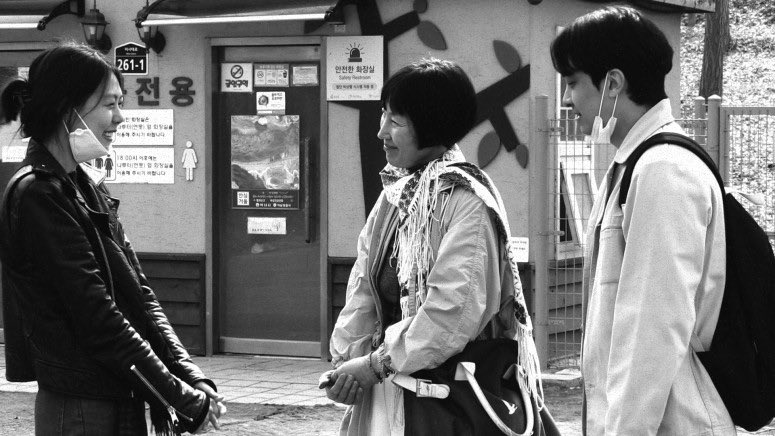
This wouldn’t be a VIFF preview if I didn’t at some point get excited about an upcoming Hong Sang-Soo film. The prolific director’s 28th feature is full of themes and images that should be familiar to fans of his work, but that should be expected at this point from a filmmaker who is known for continuously repeating himself. The differences from one Hong film to another can be quite subtle, but I would argue that this represents one of the biggest departures or evolutions in his work since he found his style (somewhere around film #3 or #4). A few jarring editing choices early on are a welcome surprise and while things stay on the rails, for the most part the closing passage is a wonderful coda to a very personal film.
Jun-Hee (Lee Hye-Young) is a very respected novelist. She is on vacation in a small town outside of Seoul. She visits some old friends and takes a break from her work. One day while walking through a park, she happens to spot an actress, Gil-Soo (Kim Min-Hee, who shares a romantic and creative relationship with the director that is the source of much controversy in South Korea) and she approaches her to express her admiration. The respect is mutual and when Jun-Hee impulsively asks the actress (who left the industry after a scandal) to star in a short film that she’s just decided she wanted to make, a friendship is struck and the plans are put into place.
Jun-Hee doesn’t have a script, nor does she have a plot or any idea of what the film will be, but insists that she MUST make it with Gil-Soo and that the rest will come later. This should ring familiar for Hong Sang-Soo fans, as the director’s unique process involves an early morning of coffee and writing, rehearsals and then shooting of the mornings scripts come later in the day, likely followed by boat loads of soju. The scripts are written entirely during filming and neither the actors, nor the director know where the film is going, or when it’s finished, until they get there. This kind of process requires extraordinary trust and an acute understanding of human nature.
Things progress as one would expect in a Hong film, as the characters get together for drinks and connect, fall apart and reveal hidden truths over tables littered with bottles, and drunken conversations drowned in cigarette smoke outside of bars. Jun-Hee eventually reveals her discontent with her own work at this point. Feeling stuck in a rut, she is looking for a way to reset or shake things up and filmmaking seems like the perfect opportunity. As the film progresses, it becomes increasingly apparent that Hong is talking about his own relationship with his art.
The personal nature of this film seems to grow as the runtime passes. Jun-Hee gets her film made and holds a small screening, which she hides from on the rooftop of the theatre where she can nervously chain smoke. I don’t want to reveal the exact nature of the ending of this film, but rest assured that the final scene is an incredible departure for Hong, both in terms of style and tone. For a filmmaker who always seems to be writing about himself, the film’s closing shots are intensely personal and a moving expression of love that blurs the lines of truth and fiction and fearlessly smiles in the face of unfair controversy. As is always the case with Hong’s work, I watched these moments through thick tears of joy.
 Crossing Borders