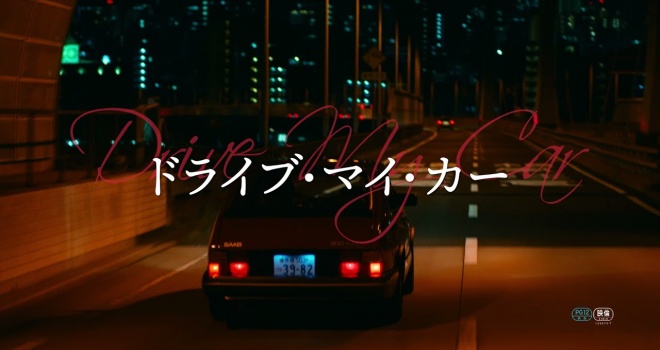
Monday Oct. 4th was a big day. I woke up with a full itinerary in mind. First I had to work a shift in the afternoon at a bar across town. Next I would bus to my father’s house to watch as much of the Los Angeles Chargers Monday Night Football game as I could before I would take a train downtown to see Ryusuke Hamaguchi’s three hour opus DRIVE MY CAR at 8:45PM. My most anticipated film of the fest. It was to be a long, full day.
You have to understand that the Chargers are to me more than just a football team that I root for. From as far back as I can remember, The Chargers were everything in my household, as close to a religion as anything. My dad was a fanatic and made sure to dress me in the blue with gold lightning bolts right away. I had a tiny #55 Seau jersey and a poster on the wall. I remember crying my eyes out when we lost the 95′ Super Bowl to the 49ers. I didn’t get to watch that game with my dad. I was too young to join, but I did watch him dye his hair blue and shave yellow lightning bolts into the side of his head the day before the big game. Our relationship went through some rocky periods, but in my teen years, we reconnected and became best friends and artistic collaborators. When he decided to move from Thunder Bay to Vancouver, I was right behind him a year later, as soon as I graduated from High School. The first night we spent together in Vancouver, we saw Bertolucci’s Il Conformista at the Pacific Cinematheque. The next night we went to a football game.
On Monday morning, as I commuted to work, I received a phone call from my dad. He wouldn’t be able to watch the Chargers game that night. He’s going to be in the hospital for a surgery. My father has been sick for years. A chronic liver disease that has been sucking the life out of him and only just 1 month ago, was he finally sick enough to be placed on the organ transplant list. His condition of late has been so poor, that we didn’t know if he would make it through the year, let alone the football season. This news on the phone was a blessing and something we’ve been anxiously anticipating for much too long. I told him I love him and before we hung up, we both said “Go Chargers!”
Of course, I was overwhelmed with emotions for the rest of the day. Fear and relief in equal measures. I cried on the phone to my wife, but was determined to go to work my shift, watch the game and get to the film screening. I called a couple friends and asked them to join me at a bar around the corner from the theatre. Those two lovely souls came through for me. Arriving at the bar, after work, the game was delayed half an hour due to lightning storms. Any Charger fan will tell you that a lightning storm is a good sign. We feed off of the lightning. We become the lightning.
The final score was 28-14 for the good guys. We dismantled the rival Las Vegas Raiders and left the field victorious and the #1 seed in the AFC. When the game finished, I bolted over to the Playhouse to settle in and watch something special. Forgive me for all of this backstory, but it needs to be laid out to explain why I couldn’t “review” this film and instead will call this a “Journal” to account for the amount of myself that I brought into that film screening. My thoughts on Drive My Car follow below:
Drive My Car follows Yusuke Kafuku a theatre actor/director. His wife, Oto is a screenwriter. When we first meet Yusuke, he is driving around in his red SAAB 900, rehearsing his lines for his role as Uncle Vanya, with a cassette tape of the whole script minus his part, recorded for him by his wife.
I grew up in the theatre. My father was an actor and producer and eventually director of small, hard hitting stage productions and I was there for a lot of it. One of my earliest memories of this involves sitting in the passenger seat of his red Mercury, as he practiced lines with a tape he had recorded for his role in a production of Chekhov’s Cherry Orchard. You can now understand my difficulty in reviewing this film from an objective viewpoint.
With that being said, I don’t think there could be a film more tailor-made for the situation I was in than Drive My Car. A heartbreaking, melancholic and life affirming tale about loss and grief, about art and the power of language. The power of storytelling. It fits perfectly into Hamaguchi’s body of work and is even better than The Wheel of Fortune and Fate, which was my favourite film of 2021 up until now. It also works as a deep and profound adaptation and extrapolation of a Haruki Murakami short story. It’s Hamaguchi’s most beautiful film and features gorgeous views of parts of Japan that I long to visit when my wife and I finally get a chance to visit her family again.
I’m writing this while enroute to Vancouver General Hospital to see my dad in the ICU. His operation was a success and while I think he will be too sedated to read this for a few days, I want to have it here and ready for him when he is able to.
My dad has always said “just one Superbowl before I die.” As a child it seemed inevitable, but recent years have felt like they were do or die. This transplant has bought him more time and I couldn’t be more grateful to the doctors who performed the surgery, the nurses taking care of him and the person, whoever they were, who passed yesterday to save my father’s life. We are eternally in your debt. Maybe now we can see Justin Herbert and the Chargers win a Superbowl. Maybe I can sit down one day and watch Drive My Car with my dad and remember those years we spent creating beautiful art on stage together. Maybe we can even work on a project together again.
Go Chargers.
 Crossing Borders