VIFF 2017 – Day 2 – Claire’s Camera

thumb_51567_film_film_big

I have a complicated relationship with the films of Hong Sang-Soo. My first Hong film was in a theatre full of Korean people 8 years ago. I remember the room roaring with laughter. The movie seemed okay, but was it really that funny? Perhaps it was a language barrier. I was frustrated. I told myself I didn’t like the film. The next year, I found myself back at another film and this time, I found myself smiling, maybe even enjoying it, but I still wasn’t sold.

I moved to Japan with my wife a few years ago and while I was there I saw the Hong film Hill of Freedom about a Japanese man going to find a woman he was with who is now back in Korea. English becomes the common language and the actors slowly work their way through the single-shot scenes. Their struggle with language seems to strip away their ego. We get to see these people for who they really are. This greatly reflected my experience of spending a year in small-town Japan. This movie felt so sincere, yet so simple and Hong played with time with such a masterful command. I knew I was wrong about him immediately.

A switch was flipped. Every Hong film I’ve seen since then has been pure joy. Every film plays out the same way. People meet, for the first time or after a long time, and they agree to go for a drink or coffee or food. Booze always makes it’s way into the picture and things escalate. It’s a simple formula, but it’s Hong’s nuance as an actor’s director and his understanding of subtext that drive the films home. He has become one of my favourite filmmakers and I struggle to rank his films, as they are basically consistently fantastic. This is a director who pumps out at least one film a year. Often two. In 2017 we have been gifted with three Hong Sang-Soo films, but only one will be screening at VIFF…

Hong is known as the “Korean Woody Allen” for his prolific output and dialogue focused films that are presented as light comedies, but often devolve into something darker or more meaningful. Hong is also no stranger to scandal. In 2016 news spread of an affair he had with Kim Min-Hee, who starred in 2015’s wonderful Right Now, Wrong Then. They openly announced their relationship in early 2017 and Hong has released three films that are drawn from this episode of their lives.

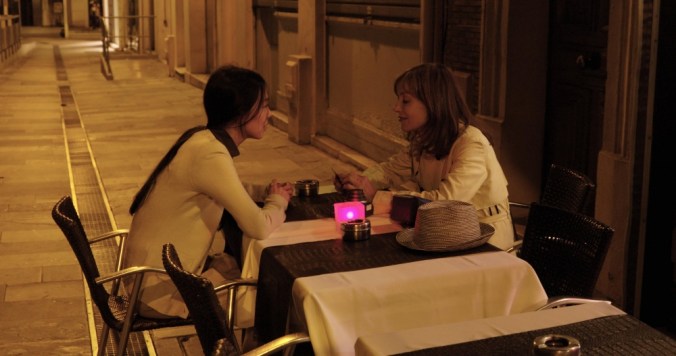
The beautiful Kim Min-Hee joins him in Claire’s Camera as the dubiously named Man-hee. She works as a salesperson for a film company and is selling a film at Cannes when her female boss dismisses her after losing trust in her for some unknown reason. We learn shortly after that Man-Hee slept with the director she works for, So Wan-Soo. She meets Claire, (Isabelle Huppert) who is on vacation, as she is introduced she exclaims, “This is my first time in Cannes.” Claire likes to take pictures with a polaroid camera. She tells her subjects that a photo is a big deal, because when your picture is taken you are changed forever.

Reality and time have a tendency to be intangible in a Hong Sang-Soo film. Sometimes it seems as if we are watching stories from different dimensions. Scenes contradict one another. Repetition and mirroring are commonly employed. Hong never loses control of all the loose ends, but rather opens the film to deeper philosophical readings.

This is my first review of a Hong Sang-Soo film. It feels like I’m just reviewing his films in general, but that’s not so bad. Every Hong film has echoes of another. Each of his films feels equally personal. Stylistically he rarely strays. This is perfect, because you know what to expect going in. You can relax and watch his stellar stable of actors hit beat after beat in long single takes. Charting the dramatic arc of a single scene can be exhilarating, as a conversation can go from small talk to tears to romance and end in a brutal fight. Hong stations his camera near a table full of empty soju bottles and captures the ups and downs with perhaps my favourite use of the zoom lens in cinema. His timing and stubborn insistence to zoom in and out over the course of a shot works for me every time. It’s a trick that shouldn’t work, but Hong knows exactly when and where to do it and the effect is intoxicating.

I have nothing bad to say about Claire’s Camera. It was a lovely break from the heavy festival fare. The cast is wonderful. The broken English provides for hilarious awkward silences and silly conversations. Kim Min-Hee’s series of collaborations with Hong have proven to be some of his best. The confessional nature of these films feels voyeuristic at times, but the lack of distance is courageous.

Funny and touching, Claire’s Camera fits well among the works of Hong Sang-Soo. If you have yet to see his films, don’t sleep on it, you have a lot of catching up to do and he will probably have released three more by the time you finish.

VIFF 2017 – Day 2 – Gukoroku: Traces of Sin

main_traces_of_sin_1-1600x900-c-default

A cold look at the social hierarchy in Japan under the guise of a murder mystery. Tanaka (Satoshi Tsumabuki) is an investigative journalist who specializes in articles about murders. He has become obsessed with a case from a year before, where a family of three was brutally killed, and sets out to interview people close to the victims. The mystery takes an immediate back seat to social commentary as we are treated to a series of flashbacks that piece together the relationships of the victims with their university friends.

Tanaka’s sister, Mitsuko, (Hikari Mitsushima) has been arrested for child neglect, she seems to be working through some kind of trauma from her past. Tanaka’s obsession with his story seems to be connected somehow to his sister’s incarceration. Perhaps he just needs the distraction.

A film told through flashbacks has a danger of being cloying or melodramatic, but first time director Kei Ishikawa manages to avoid this by keeping a distance between the audience and the subject. If you watch the trailer for this film, you will go in expecting a thriller, but there is not a single thrilling moment in Gukoroku. Tension remains low through much of the film and even the somewhat obvious plot twists are somehow presented with no fanfare whatsoever.

I feel this is the strength of the film. The focus on Japanese social status and hierarchy helps it stand out from the slew of similar films that are produced on a yearly basis in Japan. Ishikawa’s keen sense of Japanese double speak and body language provide for some really great gut punch moments. The film falters in it’s final act when Ishikawa struggles to keep all the plates spinning. There is an unfortunate kitchen sink approach to the final act of this film that may have worked in a real thriller, but feels out of place in a drama so seriously focused on a class system in Japan.

Gukoroku is a good film. A strong debut and Ishikawa’s European background and seemingly deep connections, (considering the pedigree of his cast) tells me that we will probably be seeing some interesting films coming from this guy in the near future.

VIFF 2017 – Day 1 – LUCKY

52e7ef1d44
Death is inevitable. For all of us. Many of us go early. Sickness, accidents, unforseen cricumstances interrupt the course of our lives prematurely. Very few are fortunate enough to die of “old age.”

This is explored in John Carroll Lynch’s directorial debut Lucky. A quietly funny, poignant and somehow both bleak and uplifting crowd pleaser about a man coming to terms with his mortality.

John Carroll Lynch is the kind of character actor that you’ve definitely seen in more than a few movies. In recent memory his performance as a lurching, dangerous party guest in Karyn Kusama’s The Invitation, was a treat. His menacing presence was that of a confident, journeyman actor who isn’t afraid to be unlikable for the sake of the film. Here he is behind the camera and his experience as an actor shows in the honesty and humility he draws from the cast of Lucky.

But the real reason we are all here is the titular role played by one of the greatest character actors we’ve ever had. Harry Dean Stanton, perhaps the epitome of the actor that you’ve seen, but don’t know it. A fantastic, long career with roles in some of cinema’s greatest films. Harry Dean passed away two weeks ago and Lucky serves as his swan song. How fitting that at 91, Harry is able to make a final film about a man dying from nothing but age.

Lucky opens with a closeup of a cigarette being lit. We watch Lucky as he goes through his daily routine. He rests his smoke in the ashtray to stretch, drinks a glass of milk from his fridge, and gets dressed. The rest of his day is spent walking around a dusty desert town to a cafe, a convenience store and a bar later in the evening.

Most of what we learn about Lucky comes from his interactions with the people at each of these locations. People great him with a familiarity, and it is clear these are daily conversations that probably sound the same every day. Jim Jarmusch’s Paterson comes to mind as the film cycles through this day-to-day routine. There are some surreal touches, such as David Lynch, who makes a few appearances as a close friend who’s lost his tortoise. I saw a lot of echoes from Jarmusch’s film in style and structure, but Lucky has a more somber and personal tone.

This may well be Harry Dean’s greatest and most honest performance. Physically he looks very weak, as he walks along with an uneven gait, always looking as if he may fall over. His eyes full of longing. We get the impression that this film was made specifically for him to say goodbye and it seems to be both a difficult and cathartic experience. A shot of him lying awake at night, his white, sunken face poking out from his blanket is followed by one of the most touching and beautiful moments in the film at a child’s birthday party.

Few artists have as long and interesting a career as Harry Dean Stanton. Even fewer are given an opportunity to say goodbye with one final piece. Last year’s album’s from David Bowie and Leonard Cohen are good examples of this. We are lucky to have such honest works about the end of life. This brave performance is a perfect cap to a great career.


An Introduction

As autumn arrives to Vancouver, we are once again fortunate to have the Vancouver International Film Festival (VIFF) in our backyard. Hundreds of films from around the globe flood the city for 16 days. We all hold our breath and hope the rain holds for two more weeks.

As a 12 year resident, I’ve attended the VIFF every fall. I’ve been fortunate to get the access and exposure to world cinema that I could never have imagined as a teen in my hometown of Thunder Bay, Ontario.

Every year I have written short reviews of the films I see at VIFF for my friends, family, and my own personal records. I hoped to convince people to maybe watch something they wouldn’t have heard of otherwise. Generally feedback has been positive, but Facebook is a safe place and this year I want to challenge myself and share my opinions publically.

My goal is to write some longer reviews and some shorter capsule reviews on a daily basis. I am mostly focusing on foreign narrative films, but will also be seeing some from Canada as well as documentaries.

Stay tuned, a review of “Lucky” will be up by tomorrow.


-Taylor Bishop